Welcome!
Finding Your Deep Soul brings the work into the heart of everyday life.
This third volume in the Therapeutic Shamanism series focuses on what it means to live as a whole, grounded, and authentic human being. Drawing on both shamanic practice and modern psychotherapy, it explores how Soul is not something to transcend towards, but something to embody, mature, and live from — here, in this world.
The book invites you to rediscover who you really are beneath the layers of domestication, adaptation, and cultural distortion. It is about remembering your place in the living world, and learning how to live in right relationship with yourself, with others, and with the more-than-human world.
On this page, you can explore a substantial excerpt from the book in the way that suits you best.
You are welcome to:
LISTEN
READ
Feel free to download the PDF to read offline, or to stay with the page and read the excerpt below.
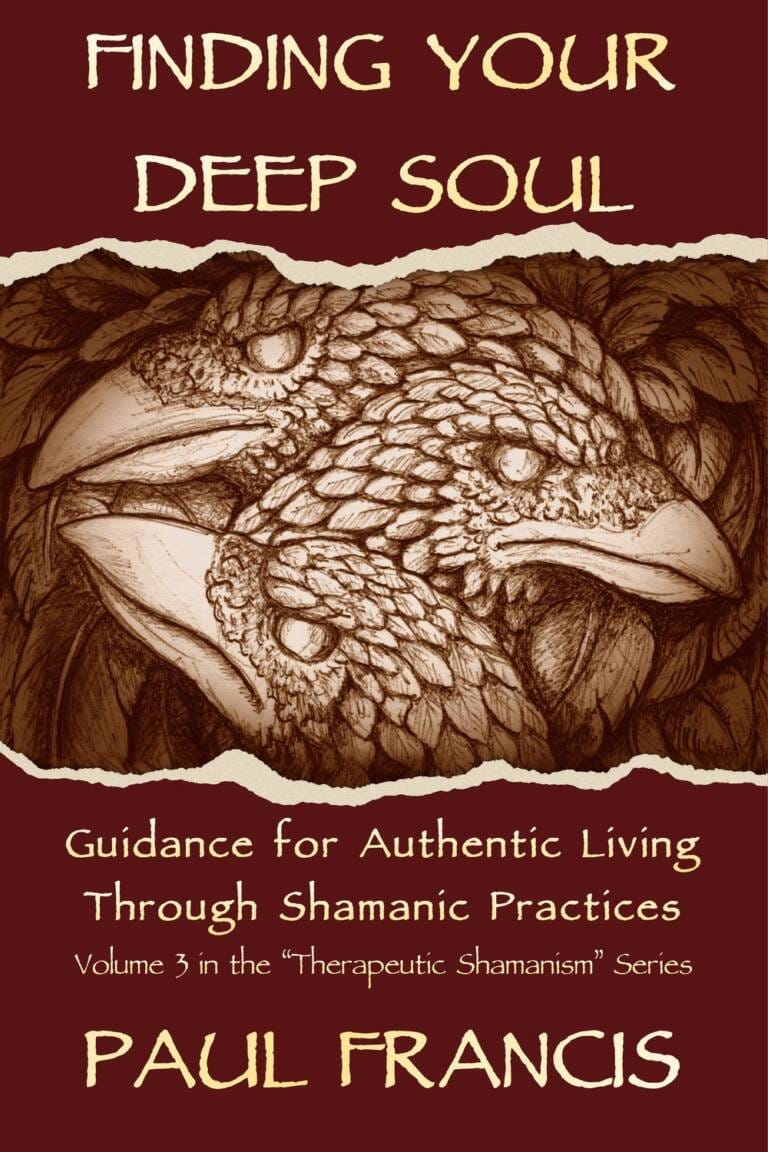
Finding Your Deep Soul: Guidance for Authentic Living Through Shamanic Practices, by Paul Francis
Excerpts from the book
Table of Contents
Each Person is a Multitude
The Main Parts of Self
Our (Healthy) Inner Tribe
The middle-world is Real!
Nature and Nurture – Soul and Environment
The Stories we Make Up
Not all Stories are Equal
Initiation
The House I Built on Sand
Digging Down to the Soul
A House Built on Soul
Real Adults are Rare
What an Adult Really is
Meeting your Soul
Growing into what you were meant to be
Chapter 4: Finding Your Deep Soul
Each Person is a Multitude
Most people see themselves as being a single “self”, a single “I” they think of as being who they are. The reality is much more complex. Each of us is made of several different parts of self, each part having their own needs, drives, agendas and stories. As we go about our daily life, we are constantly moving our sense of self from one part to another, usually without being consciously aware we are doing so. For example, people often come to therapy because they have an internal conflict, with different parts of them feeling, thinking and wanting different things. As a therapist, when listening to a client it is often clear they are unconsciously moving backwards and forwards between these different parts. Helping a client become aware of this allows them to separate their internal parts out and negotiate a healthy resolution to the conflict between them.
Like psychotherapy, shamanism also understands that we are made of different parts-of-self. Far from having the single “soul” that most people in the West think they have, shamanic cultures understood that we have several different types of “souls” within us. The number of these varied, depending on how each culture divided things up. Some cultures recognised us as having as few as three parts, whereas others recognised as many as fifteen or more. Whatever the number, it was understood that each has a different function. Some must stay in the body as they give the body life, and the body dies when they leave. Others can leave the body without causing death, such as the part that can travel the shamanic realms, or the parts that get lost when we suffer from soul loss.
The Main Parts of Self
Although we can divide the parts-of-self into any number of sub-divisions, in this book I am going to concentrate on the four primary ones. From a shamanic perspective, each of these four corresponds to (and is an aspect of) one of the main shamanic realms. This means, as we shall see, that each part has different needs. Shamanically, to live a healthy and balanced life, each part must be honoured and accepted, allowed to express itself, and its needs addressed and met.
In going through the different parts, it is important to understand that, whilst at one level everything is part of a greater whole, at another level, some parts have more sense of individuality than others do. Because of this, I am going to differentiate between “Soul” and “Spirit”. Although the two words are often used loosely and interchangeably by people, I am going to use the word “Soul” to refer to parts-of-self that have more of an identity as individual beings, and “Spirit” to refer to the part that has the least individuality. In addition, I am also going to differentiate between “Soul”—lower-world, and “soul”—middle-world. This should become clearer as you read on.
The four main parts are:
Our upper-world Spirit. This part of us is pure consciousness. It is a fragment of Father Sky (or God, if you like), in the same way that a water drop is part of the ocean, or that a spark is part of a fire. This part of us likes to soar and transcend; to rise above things and see the bigger picture. It likes to be free of the concerns of the middle-world and of everyday life. One of the reasons people often experience positive benefits from having a regular meditation practice is that, in meditation, we are connecting to this part and allowing it to do what it needs to do. This part also needs us to live in a way that is ethical and moral, kind and compassionate. If we do not live in this way then this eats away at us, and this part of us becomes ill.
Our middle-world self (or soul). This part of us corresponds to the shamanic middle-world. It is both a personal and a collective construct. It is made of the stories we tell ourselves about who we are, and of the stories society tells us. It is the domesticated, socialised part of us. It is also the part that most people identify with as being who they are. It includes our ego (our inner self-identity), and our persona (the face or mask we present to the outside world). It is also made up of two other sub-parts. These are “head” and “heart”, and each of these needs two things. Head needs to understand, and it needs to feel understood. Heart needs to love, and it needs to feel loved. In order to try and meet these needs, the head and heart make up stories. They make up stories about things like love and loyalty, duties and deceptions, motivations and meanings, rights and wrongs, all of which we weave into our middle-world story of who we are.
Our physical body. This corresponds to the physical middle-world. This part of us needs to have its physical needs met. It needs clean water, warmth, healthy food, fresh air and shelter. It needs to know that it is safe from harm, and to have somewhere it can rest and sleep. It also needs to be allowed to do what it was designed to do, which is to move around (instead of sitting at a desk, or in a car or on a sofa for most of the day). In our culture we tend to think of the body as not us, but something that we inhabit; a “vehicle” for the soul, a kind of biological car that we drive around in. In fact, many people these days are barely in their bodies at all, but ungrounded and living in their heads. The body is far more than just a vehicle though. Remember, in shamanism, everything has a soul, is alive and conscious and can be communicated with. Everything has its own unique qualities and gifts, and that goes for the body, too. Our bodies are a conscious part of us; a part of us that has its own wisdom and intelligence.
Our lower-world Soul. Unlike our upper-world Spirit, which is not so much an individual as a part of a whole, a spark of Father Sun within us, our lower-world soul is our true Self-identity. It is part of Mother Earth, but it is also the unique individual that Mother Earth intended (and still intends) us to be. The Jungian psychologist James Hillman said that, whilst our Spirit loves the peaks and dazzling heights, our Soul wants to lead us to the valleys and the depths. When we follow our Soul, we experience a sense of “deepening”. Unlike our middle-world self, our Soul is not a collection of human-made stories. It is the untamed and undiminished part of us, free of Taker cult domestication. This part of us needs to live a life that is authentic, a life that is true to our Soul. It needs to express itself in the world and be allowed to blossom and thrive. It must be connected to nature. Without connection to nature, it withers and weakens. Sadly, though, since we domesticated ourselves and turned our back on the lower-world and nature, it is a part of themselves that most people do not even know exists. It is finding this part of us that this chapter is about.
Our (Healthy) Inner Tribe
Understanding these parts shows us that, contrary to what most people think, there is in fact no one single “self”, no single “I”. Rather, we are ourselves a community, an inner tribe. Any healthy tribe is one where all tribal members feel welcome, respected, and have a voice. It is also one where there is a balance between meeting the needs of the individuals within the tribe on the one hand, and meeting the needs of the tribe as a whole on the other.
Understanding the needs of the different parts of our inner tribe, and keeping a balance between them, is essential for health. We need to get to know each of our inner parts, listen to them, and honour their needs. In doing this, we need to be mindful that we do not bring Taker cult thinking to the process. For hierarchical Taker cult “spirituality”, of course, tells us the “highest” and most “noble” part of us is our upper-world part. It tells us that the lower-world and middle-world parts are “corrupt” and not to be listened to or trusted. It tells us the story that we must deny them and “transcend them” and focus on the “light” and “enlightenment”.
I have already discussed what is wrong with this story, so I will not labour the point here. I would just add this: there is a saying in shamanism, “Does it grow corn”. It means, “Never mind the dogma, does it work?”, for generally shamanism is a dogma-free and pragmatic path. A more useful version I find, though, is to ask not just “Does it grow corn?”, but “What kind of corn does it grow?”.
The hierarchical value judgements of Taker cult “spirituality” can be hard to break free of. If you do not buy into them then you are often looked down on by those who do, pitied even, as someone who is less “evolved” and who has yet to “raise their vibrational level”. This is because hierarchical “spirituality” is exactly that—it is hierarchical. Looking “down” on people and judging how “evolved” people are comes with the territory.
If you ever find yourself getting caught up in the spell of hierarchical “spirituality”, then remember this spell-busting question. Ask yourself, “What kind of corn does this grow?”. Compared to the tens of thousands of years of non-hierarchical animist spirituality that preceded it, in the brief few thousand years of its history, the answer is that Taker “spirituality” clearly grows terrible corn. Corn that makes us ill.
Any thorough exploration of what shamanism tells us about our upper-world Spirit, and about the nature of the upper-world itself, needs a book of its own, and will be the subject of the next book in this series. The focus of this current book is to explore what shamanism tells us about our lower-world Soul, and how to find it, connect with it, and cultivate it in our lives. To explore that, we need first to understand more about the difference between our middle-world soul, and our authentic lower-world Soul.
The Middle-World is Real!
At one level, everything is indeed one. And, at another level, things are separate. Both things are true. Physical things in the middle-world are real, and pretending otherwise does not make this any less true. This is not just true of physical things, either. Although not physical, ideas can be real and have a life of their own, with all too real consequences and effects. Look at things like religions and political ideologies. Look at the ancient stories behind the conflicts in the Middle East, or the five-hundred-year-old stories behind the troubles in Northern Ireland, or the fourteen-hundred-year-old stories behind the conflict between Sunni and Shia Muslims. Totalitarian agriculture is a human story, a thought-form that has lasted for over twelve-thousand years and one that has had very real and profound effects on nearly all life on this planet.
Our non-physical middle-world part-of-self is a story, too (or more accurately, a collection of stories, beliefs, opinions, concepts and other human-made thought-forms). However, because it is composed of stories, you will often hear sky-based spiritualities (and not just the organised religions but some New Age “spirituality”, too) saying that the ego is not real; that it is just an illusion. Again, though, looked at from the perspective of Great Spirit, “self” and separation disappears, and all is indeed one. And though, back in the everyday middleworld, the ego is very much a real thing. It really does not go away by trying to ignore it or by denying its reality. Quite the opposite, in fact. For, as the saying goes, “What we resist, persists”. Even worse, when we try to deny parts of our self, we create what Jung called “The Shadow”. Rather than go away, the denied part becomes stronger and out of our conscious control, a “monster” we see as “other” to us, and which stalks us (which is why people who deny the reality of the ego, far from having no ego, often end up having an ego that seeks to dominate and control—a “guru-complex”).
The other thing that sky-orientated spirituality often tells us is that the ego needs to be “transcended”. Again, this is true up to a point. The ego does need to be reined in, as an ego out of control is indeed a monster. The sky-spiritualities tell us that the way to do this is to focus on our upper-world Spirit. The problem is, though, that this can result in a top-heavy, disembodied and ungrounded spirituality with all the negative consequences that I have already discussed. Instead, shamanism shows us that we need to rise, but rise rooted. If we are to healthily rein in our middle-world self, then as well as needing to ascend, we need to descend and cultivate our connection with our lower-world Soul.
Trying to transcend both our middle-world self and lower-world Soul by focusing primarily on our upper-world Spirit, unsurprisingly often results in becoming overly detached, other-worldly, and ungrounded. This may work fine if we can live in a monastery or as a hermit in a cave, or in some other way “renounce” the world. It usually does not work, however, if we choose to live in the middle-world in an active and engaged way. Indeed, this is why, with the Fall and the rise of the sky-orientated religions, for the first time in human history we see the emergence of things like monasteries and hermitages. These had never been needed before, because focusing on the upper-world part-of-self in this unbalanced way, and becoming disembodied and dissociated as a result, is something that pre-Fallen people had never done.
The truth is that, unless we wish to withdraw from the world, then our middle-world self is necessary and has its rightful place. The ego is not “bad”, it just needs to be of service and not in charge. From a shamanic perspective, it is the tool through which both our Soul and Spirit can express themselves and be of service to the world.
Nature and Nurture – Soul and Environment
As I said earlier, shamans say things are as they are because of their stories. Something is a stone because of “stone story”, something else is being a tree because of “tree story”, and as humans, we are as we are because of our stories, and so on. The question is, what is the “something” that is being these different things?
The “something” is Mother Earth. Everything in the lower-world is a part of her. Mother Earth, the Feminine Principle or Yin, contains within her all the Stories; the Stories of everything that ever was, is, and could be. She is the potential for everything and yet, on her own, nothing can manifest. For these potentials to manifest, Yin and Yang must come together. When Father Sky (the restless, energising masculine Principle, or Yang) seeks out and finds Mother Earth then, from the body of Mother Earth, a Soul is born.
In the lower-world, the Soul is what something was born to be. It is its truest nature; the essence of it. It is also both the blueprint for how it could manifest in the middle-world (its seed-potential), and it is the drive to try and become that thing (its actualising tendency). Looked at in this way, things are as they are because of the Stories that Mother Earth tells them to be, for those Stories are from Mother Earth (and everything is a part of her body being told a Story).
The Stories we Make Up
Remember, when it comes to the physical middle-world, things are as they are because of the interaction between two factors: their Soul on the one hand, and the physical environment around them (and how they respond to it) on the other. So, rocks are sculpted by water, trees are shaped by the wind and the direction of sunlight, animals by the availability of food and the presence of predators, and so on.
As is usually the case when it comes to humans, things become more complicated. Remember, humans are shapeshifters. Other than us humans, most things are happy to be what they are and have no curiosity or desire to be anything else. Stones are happy being stones, trees are happy being trees, eagles being eagles, and so on. We, though, are a restless, curious and inquisitive species, who wonders what it is to be something other than what we are. We wonder about how things work, about what causes things, and about what things mean. In doing so, we make up our own stories. We become shaped not just by the story of our Soul, and how that is shaped by the physical environment, but also by the stories we invent for ourselves; human middle-world stories.
When it comes to making up stories, we are exceptionally good at doing this. The stories we spin can be captivating and seductive. We can tell stories that are so entrancing and beguiling that, no matter how preposterous they are, no matter all the facts and evidence to the contrary, we still believe them. We can tell stories that enchant both ourselves and each other; spells that we become seduced and bewitched by.
Think about some of the stories that different religions spin, stories that can often be “unbelievable”, and yet stories which millions of people take as being literally true. Think, too, about the stories of charismatic politicians, the stories of narcissists, sociopaths and psychopaths—often lies and empty promises, but ones that people still fall for. Then there are the fictitious stories spun by the media. The fictions that we tell ourselves; fictions like how someone in our family must love us “really” because (so the story says) “we are family” and “blood is thicker than water”, despite all the evidence to the contrary. The story we may tell ourselves about how our partner does not mean to behave as they do (until they do, and we double down on our story, again and again). The stories we tell ourselves about how we are not good enough or lovable enough, or how we must achieve more to prove ourselves, or how we will never amount to much and so there is no point in even trying. The story that we are ugly. The body-shaming stories. The unconscious stories—that alcohol, binge eating or buying new things will make us feel better; the story that we must keep busy and never relax; the story that it is not safe to open up or be vulnerable.
Not all the stories we make up are dysfunctional, of course, for we can make up good ones, too. We can make up ones that uplift us and inspire our lives. Stories that can make us laugh and cry; that can motivate us to be better people and do good things. Stories that are good for our Souls. Stories of love, redemption, courage, bravery, compassion and kindness.
Our stories are what bond us and bind us. Societies are formed from them and defined by them. They make up the norms, mores, folkways and taboos that create social cohesion and allow societies to operate successfully; they are the glue that holds societies together. They are also what defines how we try to fit into human society, and find a role and purpose within it. Stories like teacher, plumber, engineer, musician, husband, wife, parent, friend, gay, straight, goth, punk, democrat, conservative, Christian, Muslim, Hindu, football-fan, golfer, law-abiding, rebel, joker, and so on.
Not all Stories are Equal
Our ability to make up stories is not in itself good or bad. It is, in any case, in our nature. It is part of the gift of being human, part of what we are and what we do. What is important is how we use it. To use it well, it is crucial to understand the difference between our stories, and the Stories that come from Mother Earth.
Earlier in the book, I suggested an exercise to help you think more like an animist. It involved looking around you and allowing the possibility that everything around you is alive and conscious. I suggested you try doing the exercise outside in nature, and doing in human-made environments, too, and that you notice the difference between the two. If you did this, you might have found that it is easier to experience aliveness in natural things than it is to experience it in human-made things. If so, this is a common. In teaching, I have found that generally people find it easier to experience aliveness in things like mountains, boulders, waterfalls and the wind than they do in things like chairs, shoes, cookers and so on. We generally experience nature as being alive (which, in turn, helps us to feel more alive), and human-made environments as being much less so. There is plenty of research these days that backs this up, research which shows that spending even short periods of time in nature has significantly positive benefits for our mental health and well-being.
Generally, we find being in nature to be good for the Soul. The reason for this goes back to the stories that make things what they are, and where those stories come from. To understand this, we need to pull together three threads that we have discussed at different points in the book so far.
First, remember the analogy that all the Peoples (Human, Animal, Standing, Plant and Stone) are part of a great “tree” and that individuals in the middle-world are like the tips of twigs, protruding into physical reality from the lower-world. Remember how something manifests in the middle-world is a result of the interaction between its lower-world Soul and the middle-world environment into which its Soul is protruding.
For example, an individual horse is formed from its Soul projecting from the lower-world into the physical middleworld. How the physical horse takes form depends not just on the Soul’s blueprint, but on how the blueprint is influenced by environmental factors. Then, if we follow the horse’s Soul back into the lower-world, we find that it converges with other individual horse’s Souls, to form the Horse Oversoul branch. This branch is part of the larger Mammal branch, which itself stems from the trunk that is Animal. Together with the other two great trunks of Plant and Stone, Animal makes up the great “tree” that is the Peoples in the lower-world, and which grows out of Mother Earth.
Second, remember that everything in nature is made from the body of Mother Earth; that everything is literally a part of her. Remember that the reason something is this thing rather than that thing is because of the Story that Mother Earth is telling that part of her body to be. In this sense, the Souls and Oversouls are Stories told by Mother Earth.
Third, remember that everything physical in the world, whatever else it may be, is made of the Stone People, too, in terms of the chemical elements it is built from (a horse is both a horse and a physical body made from the Stone People). Remember, though, that the Stone People are not just the chemical elements—that is just their simplest form. They are also things like Quartz Crystals and Mountains, Stars and the Sea.
Drawing these threads together, we can see that an individual horse in the physical world is the product of two sets of Stories. One set of Stories is the horse’s individual Soul, and the Oversouls that it is a part of: Horse, Mammal, and Animal. The other set of Stories are those that make the Stone People that its body is made from: Carbon, Nitrogen, Oxygen, and so on. Both sets come from the lower-world. They are Mother Earth’s Stories. They are her bringing the world into being.
Like a horse, a mobile phone is also made up of two such sets. One set is the Stories of the Stone People, the chemical elements that it is made from. The other set are the stories that make it a mobile phone (including the phone’s brand, the model, and so on). However, only one of these sets is from the lower-world and from Mother Earth—the Stone People Stories. The other set (the phone’s make and model etc.) are stories that are human-made and of the middle-world. In the lower-world, there is no “Mobile Phone” Story. There is no “Samsung” Oversoul, no “Galaxy 10+” sub-branch. This is because, good though we are at telling stories, we have no power to create Stories. In other words, we cannot create Souls. Only Mother Earth can do that.
What this means is that the things we create, aside from the chemical elements they are made from, have no connection with the lower-world. It is important to remember that this does not make them any less alive. As we discussed earlier, to shamans everything is alive, and so anthropologists reported indigenous people talking about the soul of the machete or of the outboard motor. What they did not talk about, though, is the Soul of the machete.
In other words, the things we create have middle-world souls, stories that define them and make them what they are. They do not have lower-world Souls, though, and as such (aside from the elements that they are made from), they are disconnected from Mother Earth. They are not soul-less, but they are Soul-less. Natural things, however, the things created by Mother Earth, are full of Soul.
To understand how this connects to the different parts-of-self and the quest to find our true Soul, it is necessary to realise that, whilst human-created things do not have a lower-world Soul, they can still be modelled on Soul. They can be an expression or representation of something more natural. For example, a mobile phone represents nothing natural. It has no connection with nature or the lower-world. A beautiful painting or sculpture of a horse, though, may convey something of its Soul.
Generally, the closer something human-made is to the Stories in the lower-world, the more we are moved by them. Because the closer something is to Soul, the more it calls to our Soul, too. This is why mobile phones do not move our Souls, but great art can. It is why some paintings can move us more than others (because the great ones convey something of Soul), and the same is true of stories, poems music or films. It is why informal gardens often feel more Soulful than formal ones do. It can be why some buildings feel better to us than others, why natural materials may feel better than synthetic ones, and why heavily processed food feels less nourishing than food made from fresh ingredients. Things that are closer to Mother Earth’s Stories are “food for the Soul”, whereas things that are far from her Stories feel “Soul-less” and dead.
This is true when it comes to the stories that make up our middle-world self, too. Our middle-world self is meant to be modelled on our true nature, on our lower-world Soul. To lead a Soulful life, our middle-world self needs to be an expression and representation of our Soul in our earthly life. The more this is the case, the better we feel. The further away our middle-world self is from our Soul, the worse we feel.
The problem is, of course, that most of us are raised these days with no notion of what their Soul is (or, even, that it exists at all). However, our Soul can be found. Once we find it, we can begin shaping our middle-world self around it. We just need to know where to look, and what it is that we are looking for.
Initiation
To take part in the human middle-world, we need a middle-world part-of-self. This was true for our hunter-gatherer ancestors, too, for them to be able to live and function as a member of a tribe. But, in this, there is a huge difference between our ancestors and us. In a hunter-gatherer tribe, the available roles that people could adopt would have been far fewer in number. Crucially, too, the roles would have been ones that were much closer to Soul. Like a great work of art representing Soul, their middle-world lives could be an expression of Soul, of what it is to be truly Human, as Mother Earth intended. By contrast, in the modern world, many of the roles we adopt are at best pale reflections of Soul, and most of the time, nothing to do with Soul at all. In domesticating ourselves, we abandoned Mother Earth’s Story of what it is to be Human and remade ourselves according to our own made-up stories. In doing this, we suffered massive Soul-loss, and (until we heal ourselves of this), whilst we have a soul, we have no more Soul than the other Soul-less things we create.
Whilst hunter-gatherers had middle-world selves that were more in line with their lower-world Souls, they nevertheless recognised that, in growing up, we are still constructing a middle-world self. They understood that we can become lost in the stories this part of us tells. Because of this, as I said earlier, around the time of adolescence they had initiation ceremonies. These were designed to dismantle the middle-world identity that someone had constructed in their childhood, and replace it instead with a new identity. An identity rooted in their Soul and which grew from it, in the same way that Soul itself is rooted in Mother Earth and grows from her.
I also mentioned that, because we no longer have such initiations, my Guides told me it was essential for my shamanic development that I did one. However, although this was many years ago now, it still did not happen until I was in my late 30s. Up until this point, for all the years I had spent in therapy, meditating, doing sweat lodges, encounter groups, shamanic journeys, and countless other things, I still had not met my true and authentic, lower-world Soul. In fact, I had no idea it was missing in the first place, or even that such a part of me existed at all. Of course, this also meant my middle-world self was not deeply rooted in my Soul. For all that I had worked hard on my personal and spiritual development, up until this point, I was a tree with shallow roots. [ER1]
As I was soon to discover.
The House I Built on Sand
I grew up in a nuclear family of six people. My designated role in the family was to be the scapegoat and the outsider. Mostly, whenever I spoke, I was either ignored or attacked. It was made clear to me that I was not welcome in the family. Any efforts I made to join in were always rebuffed. It was a deeply lonely childhood in terms of human contact. My solace, and my sanctuary, was nature. For a few years in my childhood we lived in an isolated, ramshackle vicarage with several acres of neglected gardens. I spent as much time as I could outside, climbing trees and hiding in dens. I studied the names of flowering plants, mushrooms and lichens. I examined the contents of owl pellets and made plaster casts of animal footprints. I watched shrews, ant colonies, newts and staghorn beetles. In those days, I did not yet have the conscious awareness I do now, the awareness that everything is alive. I was yet to fully wake up to that. At some level, though, I did know that in nature I was safe. I had a sense I was being looked after. I often had a sense of the presence of a fox at my side, looking after me. The feeling of being looked after was particularly strong around one particular old pear tree, in whose branches I used to feel protected and held.
When I was fourteen, we moved into a city and I managed to get a job that kept me busy after school and on Saturdays. This allowed me to spend as little time at home as possible, and I developed a good set of friends both at school and through work. The next twenty or so years of my life had their ups and downs, as life does. Mostly, though, they were great, both in terms of my social life and in my personal and spiritual development and learning.
During that time, I had an experience that stayed with me, although I would not understand its significance until many years later. One day, when I was in my early thirties, I went for a walk on my own. Nothing too unusual in that, except that this day I went walking in a remote and less visited part of the Welsh mountains. A couple of hours into the walk, I began to realise that I had not seen a single other human being, nor passed a house, nor heard any sign of human habitation. The further I walked, the more the lack of human sights and sounds began to feel oppressive. I began to feel uneasy. Some of this unease manifested as thoughts, like “What if I get lost?”, or “What if I twist my ankle and there is no one around to help me?” (to put this into context, this was long before the time of mobile phones and google maps!). Some of my unease was more visceral, though, and much deeper than just anxious thoughts. As I tuned into what I was feeling, I realised that I no longer felt safe in nature. I had spent most of the last eighteen years or so around people, working, socialising and partying. I had become, without realising it, disconnected from nature. Whereas in childhood, nature had been my safety and my refuge, now the wild was an alien and unsettling place to me. I had become urbanised, humanised and domesticated.
Looking back on that experience, it is so far away from who I am now. These days, spending a day in nature, away from humanity, is my idea of absolute bliss. At the time, though, shortly after having that experience, I soon got sucked back into the human world; back into work, parenting and socialising. Nevertheless, the experience stayed in the back of my mind and niggled at me. A year or so later, I was in a new relationship. My new partner had been born and raised in London and knew pretty much nothing about the countryside. One day, I took her walking in the fells in the Lake District. She was genuinely terrified. The cronking of ravens made her jump out of her skin as she had no idea what the noise was. The open spaces and the sheer size of the mountains freaked her out. If we crested a ridge on the hills and startled some sheep, she was ten times more spooked than the sheep were. She was terrified by the open expanses and the ever-changing weather. She did gradually get over her fears and started to fall in love with the place. Watching her reminded me of my own experience a year or so earlier and got me thinking again about how disconnected I was from nature (and how disconnected from nature humans generally had become).
A few years later, my life fell apart. I went through a series of events that left me with severe post-traumatic stress disorder. As well as the shock from the events themselves, I was also deeply shocked by how bad a state I was in. Given all the work I had already done on myself, I thought I would have been more robust, and yet I had gone from being happy and confident to being so suicidal that just staying alive was an hourly struggle. I talked to my therapist about this, and her reply turned out to be pivotal in my recovery. She likened the work I had done previously to my having built a house. She said that, given my lack of a healthy childhood, once I had left home I had sensibly built a new and safe house to live in. Good though this house had been, it had a hidden problem. It was built on a fault line. I could have got through my whole life without realising this, she said. However, the events that happened had triggered the fault, causing the house to come crashing down. The first job in therapy was to clear the rubble, in terms of dealing with the immediate issues facing me. Once that was done, then we could begin to dig into the foundations. In doing so, we could discover what the underlying fault had been, and so what needed to be done in order to rebuild more securely.
She turned out to be right, but not quite in the way that she intended.
Digging Down to the Soul
She was right about the house. From a shamanic perspective, the house was, of course, my middle-world self. Through the therapy I had done in my 20s, I had dismantled the rickety and leaky shack that my childhood had provided me with, and built a much better home in its place. This is what therapy is good at. It helps us deconstruct any dysfunctional parts of our middle-world self and replace them with healthier ones. She was right too that, although I had built a good house, I had unwittingly built it on a faultline. And in rebuilding, she was also right that I needed to dig deeper this time than I had before, to find out what had happened and how to rebuild in a better way. For her, this meant exploring my childhood in more depth because, as a psychodynamic therapist, she believed it was in that layer the roots of the problem were going to be found. In this, though, she was only partially right. What I was about to discover was that, to get the full answer, I had to dig much deeper still. Much, much deeper.
Think of therapy as being like an archaeological dig. It starts with a building (or the remnants of one). This is someone’s constructed, middle-world self. The ground this has been built on consists of layers of history. The uppermost layers are the person’s recent history. It is these layers that people usually start with exploring in therapy, as it is usually a current issue that prompts people to begin therapy in the first place. If people stay with the process of scraping these layers back, then what is usually revealed is the issue that brought them to therapy has deeper roots, roots that go back to the layers of childhood. It is in sifting through these earlier childhood layers things can be discovered that, when pieced together, show the deeper and truer story, and the work that needs to be done.
Although psychotherapy can go deeper than these childhood layers, usually it does not, and this was certainly the case with the psychodynamic therapist I was seeing, who referred everything back to my childhood. Whilst I gained a lot from the work we did together, I had already done a lot of work on my childhood earlier on in my life, so my hunch was that I needed to explore deeper still. Underneath the childhood layers, the next layers down are those of earlier generations. Since my therapist did not have the knowledge or skills necessary to go there (and no interest in doing so, either), I began to look for other ways to explore these layers. Doing so led me to epigenetics, the work of Bert Hellinger and Family Constellations (which we will explore in a later chapter when we look at family and tribal structures), and other avenues. It included shamanic work, too, for shamans have always known that we are affected by many generations of ancestors before us, and so I set about learning how to journey down timelines and do family and ancestral healing.
In doing this, I realised that below the layers of my more recent ancestors, there were even deeper layers. Historical and collective layers. My family carried wounds that went back hundreds of years. On my father’s side, for example, we were descended from Border reivers—raiders from the English-Scottish border country, whose history goes back as far as the late 13th century. It is not a happy inheritance. The reivers constant raiding and fighting gave us the word “bereaved”, so much misery did they cause. Their behaviour affected many generations of people who came after them, hundreds of thousands of people.
I began to see that, collectively, we are carrying wounds that go back even further still. In terms of the land in which I live, this meant back to the layers of the Dark Ages, and further back still, to the Romans and the Celts. Even back as far as the Beaker People. These were the first agriculturalist to arrive in Britain and, as is the way with the Taker cult, the people who slaughtered the hunter-gatherers that they found here, and who began to clear the land for farming. These layers carry wounds which still affect us to this day, the wounds of domestication and the Fall.
From the Beaker People, right up to the present day, the layers are full of the noise of humanity. They are full of human-made stories, stories than can largely drown out the Stories of nature. Below these Taker cult layers, though, are quieter layers; layers that are more about nature and almost free of human middle-world noise. It is these layers that Daniel Quinn refers to when he talks about the “Great Forgetting”, for the Taker cult buried them so deeply that, for a long time, we forgot they even existed. Luckily now, though, we are seeing the beginning of the “Great Remembering”, as more and more people realise these layers put things into a larger context. They show us the deeper and truer picture of what happened, and they hold the answers to what needs to be done.
In exploring these deepest layers, we can find something else, too. Underneath all our personal history, deeper than the layers of our childhood and those of our family and ancestral stories, underneath all the layers of the Fall, underneath all this domestication, our Soul is waiting for us.
It is in these quieter and simpler layers that [ER1] we can find something our animist ancestors knew through-and-through, with their heads and their hearts, with their bodies and their Souls. We can find what it is to be Human. Not our middle-world stories about being human, but the Story from Mother Earth. Out truest and deepest Story.
To do this is to finally come home. For as Bill Plotkin says, our Souls really are not separate from nature, but part of it. Our Souls really are both of us and of the world. They really are both in and of the world, “a distinctive place in nature”. As our wise animist ancestors also knew, our Souls are a potential. They wait for us to discover them and claim them. And, because we are part of a whole, part of Mother Earth herself, it is true, the world cannot be full until we become fully ourselves.
A House Built on Soul
In saying all this, I want to be crystal-clear about something. I am in no way saying that shamanism is better than psychotherapy. In the way that it is usually practiced, psychotherapy has its limitations and blind-spots, and that is true of shamanism, too. Although there is some overlap between them, each can also do things the other cannot do well. In this way, both have their place. Psychotherapy is good at replacing the unhealthy stories of our middle-world self and replacing them with healthier ones. It is good at creating healthy souls, but rarely will it help us find our Soul. Without shamanism, but with the help of therapy, I know I would have been able to build a new and improved house to live in; a sturdier one with better foundations. It would not have been the same kind of house that I did go on to build, for I still would have not met my Soul. But it is perfectly possible to live a life without Soul. It is after all what most people these days are doing. It is even possible to live a good life in that way, but it is nonetheless a life missing something.
I want to be clear about this because the idea that shamanism is better than psychotherapy is a common one in the shamanic community. It is a wonky thought, and one that leads to people not getting the kind of help they really need (I come across a lot of people in the shamanic community who could really do with psychotherapy). This is why these books are about therapeutic shamanism. Because these days, in our complicated human-made middle-world, both psychotherapy and shamanism have things to contribute. Neither is a good substitute for the other. Rather, they complement and enhance each other, and each has much that it can learn from the other.
Another thing I want to be clear about is that the process of finding your Soul does not have to be a dramatic one. You will often here it said in the shamanic community that people come to shamanism, or to finding their Soul, through near-death experiences or similar traumatic events. This is sometimes true, as such experiences can sometimes involve the death of an old way of being, allowing a new way of being to emerge. However, there are other paths, too, gentler and steadier ones, but ones that are equally effective. My own path was a traumatic one, but having experienced it, there is absolutely nothing that I can recommend about doing it that way and knowing what I know now, it is not a path I would choose again. That is why, as both a shamanic practitioner and a psychotherapist, I am keen to teach shamanism in a way that is effective and yet manageable; in ways that are grounded and trauma-free and which avoid unnecessary drama.
Those things being said, we can turn now to the practice of journeying to find our Soul. As we explored earlier in the book, having accurate prior knowledge can really help in journeying, as without it we can bring wonky middle-world stories with us, that colour and distort what we experience. That is very much true here, too, and so in seeking our Soul we need to have some idea about what it is we are looking for. One essential thing to know is that Soul is an Adult. The problem is that most people these days do not know what a real Adult looks like, so we need to address this next.
Real Adults are Rare
There is a reason why, in all hunter-gatherer tribes, people waited until adolescence before beginning the process of finding their Soul. This is because finding your Soul is an initiation into Adulthood. It is about stepping into being your authentic, Adult self. For our animist ancestors, doing this was not a problem, for children were raised by people who were real Adults and who modelled and embodied Adulthood. When the time came, adolescents knew exactly what they needed to step into to make the transition.
When it comes to us doing this, however, we have a problem. The problem being that most people these days do not know what an Adult is. What we think of as being adult are “grown-up” things such as getting a job, “settling down”, having a mortgage, and so on. These things may (or may not!) be what being a modern middle-world adult is about, but they have nothing to do with what being an Adult is about, for our Adult Soul is of the lower-world. And these days, of course, most people are cut off from the lower-world and have little or no knowledge of its existence—the place, the only place, where their Soul is to be found, for our Soul really is of the lower-world. It cannot be found in the upper-world or in exploring Spirit. Nor can it be found in the human-made stories of the middle-world.
In addition, as I said earlier, because of our lack of initiation ceremonies, most people are stuck in the middle-world identities they settled on when they were little, unconsciously playing out childhood patterns in their “adult” lives; effectively children in adult bodies. The consequence of all this, and the truth, is that in this day and age, real Adults are rare. I have met only a handful in my life and, in teaching, I have found that most people really do have no idea what the qualities of a real Adult are.
What an Adult Really is
To begin addressing this, what follows is a list of the qualities I see as being characteristic of an Adult. In compiling the list, I have drawn on the qualities I have observed in my Human lower-world Guides, and from what they have taught me about Adulthood initiations. I have also drawn on what I know from anthropology, and from psychotherapy (particularly from Rogers, Maslow, Reich and Jung). The list has also been road-tested in several training groups over the years and has been modified and refined by them. It continues to be work in progress, however, and I am not claiming it to be a definitive list. Like everything in this book, I am simply offering it as suggestions, so feel free to add things or remove things as you see fit.
In reading through the qualities, some may seem obvious, though some may seem less so. For instance, one characteristic listed is “Does not take more than their fair share of resources”, and another is “Seeks to distribute resources fairly”. Given that we live in a culture that sees the acquisition of wealth as one of the hallmarks of being a successful grown-up, these two qualities of Adult may not seem obvious. What is important to remember is that we are looking here at what an Adult would have been in a hunter-gatherer culture. We are looking for the healthy template in the layers below those of the Taker cult. Most people these days tend to think of adulthood as being about things like “standing on your own two feet” and being “independent” and able to “support yourself”. This is because the Taker cult is all about separation and isolation. In an animist tribe, being Adult was about interdependence, not independence. This is because the experience that we are all interconnected is at the heart of animism. It is also because the survival of the tribe depended on the Adults operating from a place of interdependence.
Remember, viable hunter-gatherer tribes were small units, consisting of as few as 20 people, and not more than around 200. They lived in a literally hand-to-mouth way, and alongside dangerous wild animals, and with little or no personal space or privacy. Hunter-gathering could be precarious. It is worth remembering that not so long ago there were other hominid species besides us, including the Neanderthals and the Denisovans, all of whom went extinct. We ourselves came close to extinction at times. Genetic analysis suggests that around 70,000 years ago, for example, there were as few as 2,000 of us Homo sapiens in the entire world. We survived because we cooperated with each other.
In order to survive, a hunter-gatherer tribe had to be a high-functioning team, where people got on with each other, trusted each other, and had each other’s backs. Any tribe where there was interpersonal strife, factions and resentments would not have survived. Because of this, things like sharing resources fairly, so that there was no resentment and so that everyone got what they needed, were not just desirable traits, but essential traits of being an Adult. This is why, from all over the world, there are accounts in anthropology of indigenous people saying that if they had any surplus then they had to share it. The world over, this was an essential trait of being an Adult; keeping surplus for oneself was to behave like a child. So, too, traits seeking to “enhance social cohesion” and being “inclusive rather than divisive” are not just desirable, either, but intrinsic to being an Adult. Looked at in this way, the essential qualities of an Adult describe not an individual, but a role within a community; an essential role if that community is to be a healthy and high-functioning one.
Here is the list.
A True Adult:
- Is grounded, present, and embodied.
- Has a good degree of self-awareness.
- Is reality orientated.
- Is willing to face the truth and see the world as it is (rather than how they would like it to be, or how they think it “should” be).
- Is willing to accept responsibility for their own choices, actions and behaviour.
- Is open to learning from their mistakes.
- Is open to feedback.
- Sets and maintains appropriate and healthy personal boundaries.
- Is willing to step into and own their personal power and authority.
- Does not unhealthily hand their power over to others.
- Knows the limits of their power.
- Uses their power wisely and constructively.
- Seeks to empower others where possible and appropriate.
- Is reliable and dependable.
- Is congruent.
- Is in touch with their feelings and emotions.
- Can show vulnerability when appropriate.
- Can ask for help and support when needed.
- Is empathic and compassionate.
- Can engage in healthy parenting when appropriate (including nurturing, setting healthy boundaries, teaching and protecting).
- Is a good role-model.
- Has healthy self-control and self-discipline (mental, emotional and physical).
- Contributes constructively to their community.
- Supports others.
- Treats others with respect and dignity, including the other-than-human members of the community, too.
- Seeks to enhance social cohesion.
- Is inclusive rather than divisive, and accepting of difference (whenever possible and appropriate).
- Is willing to act for the greater good when necessary, rather than purely for personal gain.
- Does not take more than their fair share of resources.
- Seeks to distribute resources fairly.
- Is competent in their chosen roles and tasks.
- Lives ethically, honourably, and with integrity.
As I said, I am not claiming this is a definitive list. There may be things you disagree with, and other things you think should be included. The point here is not whether the list is “right” or not. Rather, it is to think about the issues, and in doing so, strip away wonky Taker cult ideas about adulthood, ideas that would otherwise get in the way when it comes to journeying to find your Soul. To help with that, here are a couple of exercises.
Exercise 12: How Adult Are You?
Take some time to go through the qualities of an Adult and reflect on how they apply to you.
Be honest with yourself in doing this. It is not an exercise in beating yourself up, though. It is an exercise in being Adult. That means facing the truth and being open to feedback (from yourself). It also means being compassionate and empathic with yourself, too. For, given the lack of healthy modelling in this culture, if you are even halfway towards being an Adult already, then you are doing well.
When going through the list, take your time. Really reflect on each of the qualities.
In doing so, if you find ones that need developing in you, make a note of them. Then, take each of these one at a time. With each one, take as much time as you need—a day, a week, a month, a year—however long it takes, to reflect on it as you go through your daily life. Practice it and notice how it feels to be coming more from that place.
Exercise 13: How Many Adults Do You Know?
Looking at the list of Adult qualities, think about how well they apply to people in your family, or in your work environment, or in other groups you belong to.
Then, try to think of as many people as you can who you feel embody the qualities of Adult. These can be people you have met in your life, famous people, or even fictitious people.
Notice how rare true Adults are (compared to hunter-gatherer tribes, where every adult was an Adult).
Reflect on how much we need Adults back in the world.
Reflect on how that means it is your responsibility to choose to be an Adult in your life.
Meeting your Soul
In a moment, I am going to go through how to journey to meet your lower-world Soul. In order to do the exercise successfully, though, there are just a few other things that need clarifying first. One is that there really is no point doing this exercise unless you feel ready. Becoming an Adult is a process, not an event, and will take time. However, you really do need to be ready to begin that process for it to work. If you embark upon it when you are not, then you are setting yourself up to fail. So be honest with yourself and take your time to do any needed preparation first.
It is also important to understand more about what it is you are looking for, so that your intent in the journey is as clear as possible. It is important to be clear what you are looking for is an Adult Human. Because your true lower-world Soul is not some abstract thing. It is not going to look like a glowing ball of energy, or a fairy, or some kind of winged beast. Your lower-world soul is You. The specific, individual healthy Human Being that you were, and are, meant to be.
Probably the easiest way to understand this is to think about what you would be like as an Adult had you been raised in a healthy hunter-gatherer tribe. Brought up by parents who knew how to be good parents. Raised in a high-functioning, well-bonded, emotionally-intelligent and supportive group, and by people who wanted to help your Soul blossom. An Adult who spent their childhood playing outside and in nature. Who lives a life where their body can do what it is designed to do, and what is healthy for it. An Adult who is free of possessions (objects), and of possessions (things they are possessed by). Someone who is free of soul-loss and of power-loss. Who experiences the world as an animist, as an inter-connected being, alive to the aliveness of the world around them.
If you had been raised in this way, what would you be like? What would be your role and place be in the tribe?
This is the person you are going to meet. They need to look something like you, as they are, after all, the lower-world blueprint for your body too. They will almost certainly be healthier and fitter, as hunter-gatherer lifestyles were physically active, and, contrary to what most people think, the diet was often healthier than most modern-day ones. Sometimes, they may not be the same sex as you are in this physical world, though, but only if this feels right to you and makes sense.
On that last point, things feeling right to you is crucially important with every aspect of meeting your lower-world Soul. Maybe in your life you have met someone you click with. You feel at ease with them and feel they “get” you, and that is almost as if you have known each other for years. Or maybe you have known someone for years, someone who you feel does grok you, and who you feel at ease with. The thing is, though, that no matter how much a “soul mate” they may feel to you, no matter how much of a kindred spirit, they are still someone else. Your Soul, on the other hand, is you yourself, the person who you should feel, at some level, the most kinship with. Depending on how far your middle-world self is from what they are like, they may feel strange to you at first, like someone who has lived another life altogether (they have!). And though, at another level, if they are your Soul, then there will be a deep familiarity about them too. That is why it is important that your Soul, in the form of the lower-world hunter-gatherer you are going to meet, feels right to you. If not, then move on and try again, either in the same journey or in another journey later on.
In doing the journey, it is of course crucial you are definitely in the lower-world since, because your Soul is of the lower-world, that is where they are to be found. Remember then that the lower-world is the realm of wild nature. It is entirely free of any signs of human domestication, including agriculture. There is no farming. No fields or hedgerows. The people there do not own herds. Remember that the humans in the lower-world are Stone Age People. So, your Soul will not be wearing any metal jewellery or carrying metal knives. Any clothing they are wearing will be made from animal skins or natural fibres.
Exercise 14: Meeting Your Lower-World Soul
The intent of this journey is to go to the lower-world to meet your own Adult Soul.
Prepare yourself for doing a shamanic journey, doing whatever works for you.
Start the drumming.
Go to your Axis Mundi and deliberately and consciously hollow-out. Take your time doing this.
Then tell your Guides you wish to be taken to the lower-world to meet your Human lower-world Adult Soul. When ready, set off to the lower-world with your Guides.
As always, follow your Guide’s lead and directions. Remember, you are looking to meet Yourself as the Adult you would have ideally grown up to be in a healthy hunter-gatherer Tribe. Once you do meet them, do take time to check out if things feel right, and check with your Guides too. If things do not feel right, then set off with your Guides again and keep looking.
When you do find your Soul, greet them. Then notice details about their appearance—their hair, the colour of their eyes, the shape of their nose, what they are wearing, if they have any jewellery or tattoos etc. Make them as solid and detailed to you as you can.
Ask them their name (your lower-world name).
Then, ask them if there is anything they wish to show you, or anywhere they want to take you (staying in the lower-world). Generally, spend time with them and get to know them.
If it feels right and appropriate, you could also try becoming them—shapeshifting into them and noticing how it feels to be them.
On the call-back, bring them back with you, either alongside you, or by bringing them back with you into your physical body.
Afterwards, as always, write down what happened in as much detail as you can remember before your left-brain starts to erase bits from your memory.
Growing into what you were Meant to Be
“To think about the Soul, to think about it at least once in the confusion of every crowded day, is indeed the beginning of salvation.”
– Georges Duhamel
Meeting your Soul is the beginning of a process. Having met your Soul, the process then involves allowing your Soul to start shaping your middle-world life. To do this, you need to begin to cultivate the habit of checking in with it. Ask it what it would do, and for its advice. Your true Soul is, of course, a wild and free animist hunter-gatherer, because that is literally what we are designed to be. Because of that, though, you may think your Soul has little to offer that will be of practical use in your daily life, given how far our lifestyles are from those of hunter-gatherers. If so, then I can only say that from my own experience and from watching students, I have found the opposite to be the case. The Soul provides an anchor that stops you drifting and getting lost in the stories of the human-made middle-world. The human middle-world is cluttered and “sticky”, and this can be true of our middle-world self, too. If we let it, our middle-world self can draw us in and entangle us with its stories and dramas. By contrast, our Soul is a calm, clear and wise voice. When we listen to it and centre ourselves in it, much of the noise and clutter of the middle-world just drops away. We gain perspective.
We can gain this perspective and healthy degree of detachment from the middle-world by being centred in our upper-world Spirit, too, of course. This is because both Soul and Spirit transcend the middle-world. As well as healthy detachment, though, Soul brings something else. It brings answers. Answers about how to live in the world and about who to be in the world. Soul provides the healthy Templates on which to base an authentically-lived life. Your middle-world self will then need to translate and adapt these Templates, to make them relevant and useful in your everyday life and the environment in which you live, but doing that is the correct and healthy role of the middle-world self. By being the channel through which the Soul can flow into the world, rather than being lost and adrift in human-made, middle-world stories, the middle-world self becomes anchored in Mother Earth and part of her again.
As well as referring to your Soul for guidance, another important practice is to regularly shapeshift into being your Soul. This does not work if it is only done in your head. It must involve your physical body. You need to feel what it is like to be that wild and free hunter-gatherer; shapeshift into them in a somatic way. By doing this, gradually your Soul becomes more embodied and present in your daily life. If you do this, then, little-by-little, you will find your default notion of who you are gradually shifts from being your middle-world self, to being your Soul instead.
These practices actually work. Along with the other animist and shamanic practices, they really do start to change how you experience the world and wake you up to its aliveness and interconnection. It is simply a matter of doing them. That is all it takes (and, as a bonus, they are mostly fun and enjoyable to do).
And, in doing them, not only do you gradually become whole yourself, but by taking your rightful place in the world, you are helping the Earth herself to become whole too.
Buy online from your favourite book shops





First-Steps Course
Learn Shamanic Journeying
Our next First-Steps course starts on 14 November 2026. It’s a six-week online introduction to shamanism, animism and shamanic journeying, with live sessions (all recorded), weekly video modules and a lively international discussion group.
£80 for the course