
Most of us go through life treating death as the thing that ends it.
Something to be managed, postponed, not looked at too directly. We know it’s coming. We just don’t particularly want to think about it until we have to.
And when we do, we reach for reassurance.
Reincarnation. Continuation. The idea that the self goes on.
From an animist perspective, these are relatively recent ideas. They arise after the Fall – after domestication, after we lost our original place in the web of life. Our hunter-gatherer ancestors held death very differently. Not with denial or consolation, but with intimacy, realism, grief, and reverence.
They understood something we have largely forgotten: that a sane relationship with death is not morbid. It is one of the most clarifying things a human being can cultivate.
- In animism, death is not continuation but separation: the five parts of self (Spirit, Soul, Body, Ego, and Aware Self) come apart and each goes somewhere different.
- Where your awareness goes at death depends almost entirely on where you have habitually directed it during life.
- Reincarnation is not part of original shamanism. It is a belief that emerges after the Fall, roughly 4,000 years ago, and is not found in genuine hunter-gatherer cultures.
- The unquiet dead are people who have died but not moved on. Their proximity affects the living in ways modern culture rarely recognises.
- Grief is not a problem to solve but a natural process. Interfering with it - rushing or suppressing it - causes lasting harm.
- A sane, grounded relationship with death is one of the most clarifying forces available to a human being. It does not make life feel smaller. It makes it feel more real.
What Happens After We Die?
The realm of speculation
The first thing I always say about death is this: nobody actually knows what happens. Some people have very strong opinions about it. Different cultures and religions often have quite different ideas.
Near-death experiences are frequently offered as evidence, but when you look at cross-cultural studies, people from different cultures tend to report different things – which strongly suggests that what they’re experiencing is shaped by their own beliefs and middle-world self, rather than some objective picture of what lies beyond.
So we are in the realm of speculation. And that is actually the most honest and useful place to start.
Most spiritual teaching on death offers certainty
Reincarnation. Eternal life. The soul ascending to some higher plane. These are reassuring ideas – and from an animist perspective, they are relatively recent ones. They emerge after what animists call the Fall, roughly 4,000 years ago, alongside the rise of agriculture, hierarchy, and what some researchers call the ego explosion. They are not part of original human wisdom about death.
More than that: they are unhelpful.
When death can be transcended - when the self simply moves on, continues, ascends - you no longer need to take this life seriously as the only one you have.
And that costs you something.
It costs you the very thing death most wants to give you: the clarity that comes from knowing this is finite, this matters, and the way you spend your awareness now is what shapes everything.
The animist starting point – that nobody knows – is not a weakness. It is the doorway into actually learning from death, rather than managing it at a safe distance.
| Modern Western View | Animist View | |
|---|---|---|
| What death is | The end of the self, or a transition to another form of continuation | Separation - the inner tribe comes apart. Not continuation, not extinction. |
| Reincarnation | Widely believed in spiritual communities | Not part of original animism. Appears only after the Fall, ~4,000 years ago. |
| The dead | Remembered, sometimes kept close; rarely worked with | Must be helped to move on. Psychopomping was a central shamanic role. |
| Grief | A problem to process and move through; stages to complete | A natural process with its own pace. Interfering with it causes harm. |
| Endings | To be managed, reframed, or minimised | Essential. Without real endings, real beginnings are not possible. |
| What death teaches | Little - it's an ending to be survived or transcended | How to live - with clarity, presence, and awareness of what actually matters. |
What a human being actually is: the animist inner tribe
To understand what happens at death, we first need to understand what a human being actually is. The animist answer is more complex than most modern frameworks allow for.
From an animist perspective, we are not a single self. We are a temporary coming-together of different parts (what I call the inner tribe) that assembles for a lifetime and then separates. Death, in this view, is not continuation. It is separation.
And that distinction matters enormously for everything that follows.
Animism identifies five distinct parts of self
Spirit is our upper-world aspect – the part of us connected to the vast, transpersonal dimension of existence, like a drop of water in an ocean. At death, Spirit returns to that ocean. There is no individual continuity. It becomes part of something much larger.
Soul (with a capital S) is our lower-world aspect, part of the human over-soul and the great tree of life. This is the part that is most distinctly our own – not in the ego sense, but in the deeper sense of what makes us who we are beneath the accumulated stories. Crucially, Soul is the part that can be cultivated during life. Soul that has been found and tended becomes something that can be followed at death. A Soul that was never attended to cannot be followed, because it was never fully there.
The body is made of what animism calls the Stone People – the minerals and elements temporarily dancing as flesh and bone. At death, the body returns to the earth and becomes part of other things.
The ego, or middle-world self, is the story of who we are: our identity, history, and accumulated sense of self. This is the part most of us think of when we say “I.” It is also the part most afraid of death – for obvious reasons.
The aware self, or witness, is the most misunderstood part. It has no personality, no emotions, no history of its own. It is simply awareness – an inner torch that can be directed toward any of the other parts. Where it goes at death depends almost entirely on where you have practised directing it during your life.
What happens at death: separation, not continuation
At death, the inner tribe comes apart.
Spirit returns to the upper world. Soul, if it has been cultivated, returns to the Lower-World and the Human Oversoul. The body returns to the earth. The ego – the middle-world self – fades over time. And the aware self follows whatever it has been most deeply identified with throughout life.
This is why shamanic practice matters as preparation.
If you have spent your life almost entirely identified with your ego and your middle-world story, that is where your awareness goes at death. The ego fades, and awareness fades with it. If you have practised directing your awareness toward Soul, toward Spirit, toward something larger than the personal story – that is where it follows.
There is a story often told about Gandhi. When he was shot, he fell to the ground chanting the name of God, and reportedly looked at peace. For most of us, if we were shot, we would fall chanting something very different – because that is where we habitually are. The point is not to judge this, but to notice it:
How you die will largely be determined by how you have lived, what you have practised, and where you have habitually placed your awareness.
That is not a morbid thought. It is one of the most clarifying things I know.
The ego and death
the leaf on the tree
Your middle-world self – your identity, your ego, the story of who you are – is like a leaf on a tree. It has a season. While it is alive, its purpose is to serve the tree: to do its job, to contribute what it can to the larger whole it is part of. And when the time comes, it falls.
A healthy leaf, when it falls, gives its nutrients back to the tree. It composts. It becomes part of what feeds the next growth.
A diseased leaf, one that spent its time claiming independence from the tree, focused on its own importance and accumulation, contributes nothing in return. It just stops.
Our middle-world egos, in modern culture, have become very good at claiming independence from the larger tree. At believing in their own immortality.
Death, kept honestly in awareness, is the thing that keeps reminding the leaf what it actually is.
And in doing so, it keeps pointing us toward what matters: not the story of the leaf, but the tree it is part of. The people around us. The living world. The larger whole we are, for a season, one small thread of.
"What did your life feed?"
That is the ecological question death is really asking.
Not in a judgmental way – there is no weighing of deeds in animism, no reward or punishment. These ideas belong to fallen cultures, to religions that used death as a tool of social control.
Animism has no equivalent. What it has instead is something ecological rather than ethical. A leaf that composts feeds the tree. A leaf that doesn’t, doesn’t. There is no court, no sentencing. Just the simple fact of what was given back and what wasn’t.
Did the way you lived contribute something to the tree? To the people around you, the living world, the larger whole you were part of? Or did it remain turned entirely inward – accumulating, protecting, proclaiming its own importance?
When you sit with that question honestly, it rearranges things.
What our hunter-gatherer ancestors understood about death
Hunter-gatherer cultures held death very differently from how modern culture does. Not with denial. Not with consolation. Not with the reassurance that the self continues in some form forever.
Instead, it was a relationship with death characterised by intimacy, realism, grief, and reverence. Death was not kept separate from life. It was woven through it. The ending of things – seasons, relationships, roles, life itself – was understood as essential to how life stays healthy and alive. Not a problem. Not a failure. A completion.
I visited an exhibition at the Tropenmuseum in Amsterdam some years ago, organised chronologically to show how different cultures dealt with death. The pattern was unmistakeable. The most ancient, genuinely hunter-gatherer cultures were unambiguous: the dead must leave, and leave cleanly. Giant carved doors in yurts used only to carry the dead out, then barred against return. Tall carved poles with inscriptions commanding the dead to go. As cultures became more settled, more fallen, they began keeping the dead close. Skulls on mantlepieces. Annual exhumations. Urns inside the home.
They stopped psychopomping. They stopped helping the dead move on. And in doing so, they lost something essential.
By most meaningful measures, we are a far less mentally and spiritually healthy culture than those hunter-gatherer societies were. And much of that disconnection traces back to our relationship with death – to the fact that we have spent so much energy trying to explain it away, soften it, make it not quite final, rather than learning from it.
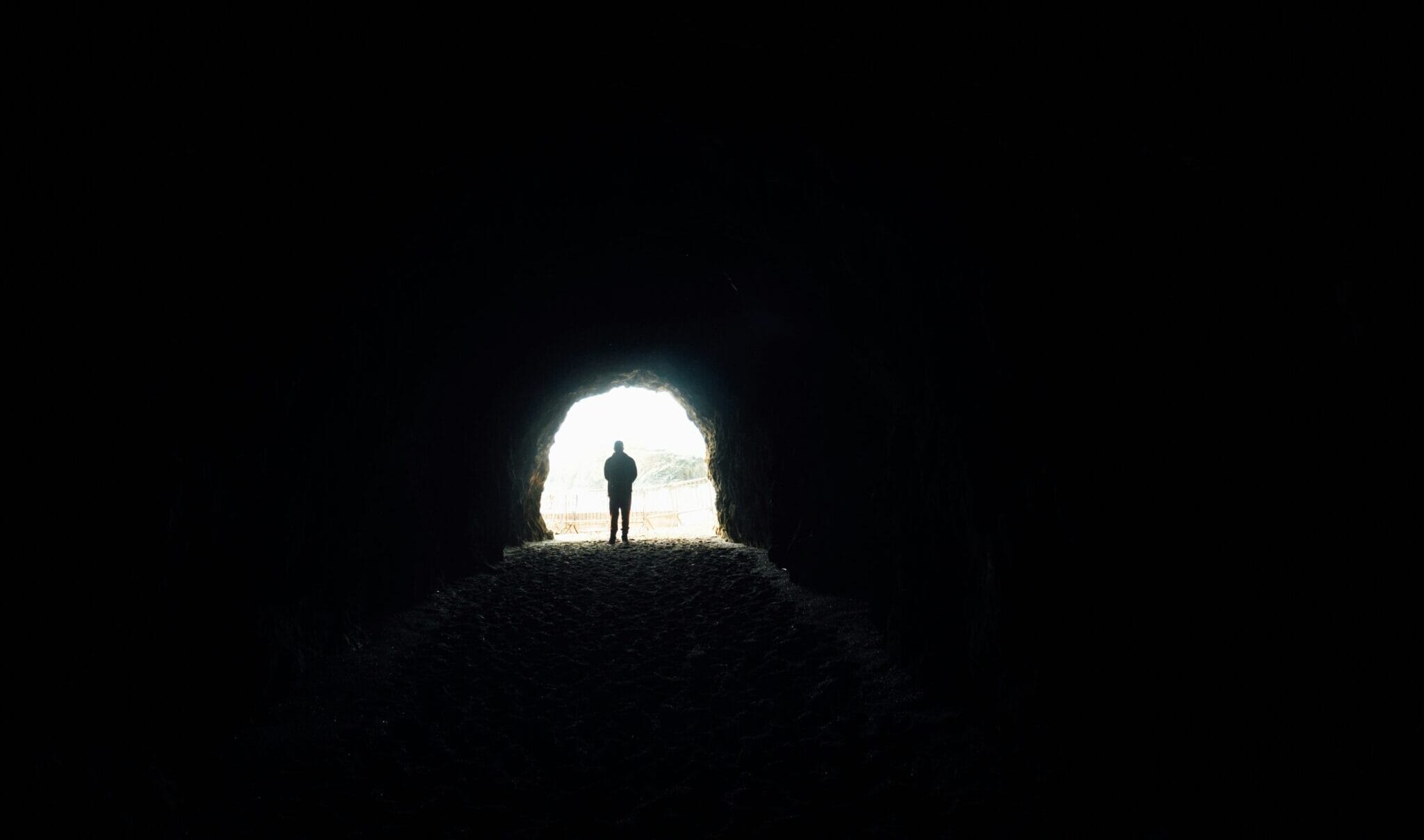
Why endings need to be endings
One of the most practical things death teaches us, long before we die, is about endings.
Things need to be allowed to end. Not just physical death. Relationships. Phases of life. Identities we have outgrown. Beliefs that no longer hold. Ways of being that have run their course.
Modern culture is deeply uncomfortable with this. We cling, prolong, repack. We try to move from autumn directly into spring, skipping winter altogether. And then we wonder why new beginnings never quite feel fresh – why they arrive already carrying something heavy, something that was never fully let go.
From an animist perspective, the reason is straightforward: energy that should have been released is still being held. Something unfinished is taking up space, consuming life-force, creating a low-level stagnation. It will keep doing so until it is properly allowed to end.
Winter, in nature, is not a problem. It is essential. When things are allowed to die back properly - to compost, to settle, to go dark - the soil renews in a way that nothing else can replicate. What grows from genuinely composted ground is actually new. Not rearranged. Actually new.
This applies to grief as much as anything else. When something real ends – and we grieve it properly, at its own pace, without rushing or managing it – something essential settles. Space opens. And what comes next can actually be next, rather than just more of the same thing with a different name on it.

Why grief is not a problem to solve
Grief is the natural companion of every real ending.
Our culture has profoundly misunderstood what grief is. We treat it as a problem – something to be processed, moved through, eventually resolved. We talk about getting over things, as though grief were an obstacle between who you were before a loss and who you will be on the other side of it.
From an animist perspective, grief is not an obstacle. It is a process – the natural movement of loss through a person. Like all natural processes, it has its own pace, its own intelligence, its own season. The only way it goes wrong is when we interfere: rush it, suppress it, decide we should be over it by now.
When grief is not allowed to move at its own pace, it doesn’t disappear. It goes sideways. It surfaces as numbness, flatness, a strangeness in experiences that should feel alive. It shapes things in ways we often don’t recognise.
Many of us are carrying more grief than we know.
Not just personal grief, but collective grief – for what has been lost in the shift away from a more sane and connected way of living. Ecological grief, for the living world we have watched diminish. And ancestral grief – unresolved loss passed down through generations, shaping us in ways we rarely notice until we look directly at it.
The unquiet dead and the role of the psychopomp
The dead who linger do so for recognisably human reasons: unfinished business, being held back by a grieving person who won’t let go, fear of what comes next, or confusion around not knowing they are dead. The reasons are very human. But proximity to the dead costs the living something – whether we recognise it or not.
Animist cultures understood something modern culture has largely forgotten: the dead need to move on too.
When a person dies but the middle-world self doesn’t complete the transition – lingering instead in the world of the living, caught between worlds – it creates problems. Not because the dead are malicious, but because death energy is not life-friendly. Prolonged proximity to it drains the living.
This is why one of the most important roles in animist cultures was the psychopomp. The word comes from the Greek psyche (soul) and pompos (guide or conductor). The psychopomp’s role was to guide the dead onward: not as an act of banishment, but of compassion. Helping a completion to complete.
I find cities increasingly difficult to be in these days. One of the reasons is exactly this: walking down a street in most cities, you are walking through a great deal of unquiet dead. We have stopped psychopomping. We have filled the middle world with people who haven’t moved on. And we are affected by that, far more than we realise, in ways that show up as heaviness, flatness, a sense of something not quite right.
Learning to understand and work with this – knowing how to maintain clear boundaries between the world of the living and the world of the dead – is part of what it means to have a healthy, grounded relationship with death.
Keeping death behind the shoulder
the shamanic approach to mortality
Shamanic traditions sometimes describe keeping death just behind the left shoulder – not as a morbid obsession, but as a quiet, steady awareness:
All of this is finite. You are here for only a season, not forever.
This awareness, when it is grounded rather than anxious, has a clarifying effect that almost nothing else matches. It cuts through noise. It makes presence easier and pretence harder. It keeps pointing us back, quietly but persistently, toward what has real weight and away from what doesn’t.
A shaman is not someone enamoured with death. A shaman is someone who has accepted death fully enough to learn from it - and in doing so, to live more honestly and more fully.
A PATH TO ELDERSHIP
There is a quality that grows in people who have done this over time. Animism calls it eldership, meaning not merely age, not seniority, but the particular kind of clarity that comes from having lived long enough, let enough things die, and accumulated the perspective that real loss, when properly grieved, properly honoured, produces.
People who carry eldership tend to have a quality of simplicity. Not easy answers. But a sense of what matters. An ability to see through the noise that preoccupies ordinary life to what actually has weight.
Modern culture has largely lost the conditions that produce this. We valorise youth, productivity, constant forward momentum. The long view is not much in demand.
But it is available. It grows, quietly, in the people willing to look at death honestly – not to court it, not to romanticise it, but to let it teach.
People who have sat closely with death – who have worked with the dying, who have allowed themselves to grieve properly rather than managing it at a distance – tend to arrive at something similar. A simplification. A shedding of what was never really essential. A clearer sense of what the time they have left is actually for.
Elizabeth Kübler-Ross spent her life working with the dying. At a public talk near the end of her life, she was asked what single lesson she had taken from all of it.
Her answer was two words:
“Lighten your load.”
It is, when you sit with it, a profoundly shamanic answer.
What are you practising?
The novelist Daniel Quinn, writing near the end of his life, observed that it is often only in looking back that we can see the moments when our soul was calling to us – the times when something deeper was reaching through the noise of ordinary life, asking us to change direction, to pay attention, to honour something that mattered more than what we were currently busy with.
Death, held honestly in awareness, makes those moments easier to hear while we are still living them.
Because this is what it comes down to: your life is a practice. Everything you do is a practice. What you habitually direct your awareness toward, what you repeatedly identify with, what you consistently feed with your time and attention – that is what you are practising.
And how you die will largely be shaped by what you have been practising.
That is not a morbid thought. It is one of the most useful thoughts I know. Because it means the question of how to prepare for death is identical to the question of how to live well, now, in the time you have.
What are you practising?
What is your life feeding?
What do you want to do with the time you have?
Those are not philosophical questions. They are shamanic ones. And they get sharper, and more useful, the more honestly death is kept in view.
I want to end with Mary Oliver’s words.
“When it’s over, I want to say: all my life I was a bride married to amazement. […] I don’t want to find myself sighing and frightened, or full of argument. I don’t want to end up simply having visited this world.”
— Mary Oliver, When Death Comes
An invitation: How to Live and How to Die Course
Everything explored in this blog: the inner tribe at death, what the parts of self do when they separate, the unquiet dead, psychopomping, endings, grief in its many forms, what it means to cultivate soul, and what death teaches us about how to live, is explored in depth in the Further-Steps course How to Live and How to Die.
On the course, you will:
- Learn the full animist model of what happens at death – the inner tribe, the separation of parts, where each goes and why
- Understand the Land of the Dead: what it is, why it is dangerous for the living, and how to maintain healthy boundaries between the worlds
- Get your own psychopomp guide and learn to work with the unquiet dead safely
- Work with endings through the Wheel of Life – understanding why things need to be allowed to die back, and what gets in the way
- Work with grief in its multiple forms: personal, collective, ecological and ancestral
- Explore what it means to find and cultivate your Soul – and why this is the most important preparation for death there is
- Do a year-to-live practice – one of the most clarifying exercises in shamanic work
- Journey to meet your older and future selves
- Do soul retrieval focused on the times in your life when your soul was most clearly calling to you
- Lighten your load – identifying what you are still carrying that is ready to be put down
The course runs July–August 2026 and is unlikely to be offered again before 2030. It is open to students who have completed First-Steps and at least one Next-Steps or Further-Steps course.