Most modern spiritual teachings offer us a kind of reassurance about death: eternal life, reincarnation, ascension, continuation. From an animist and shamanic perspective, these ideas are relatively recent. They arise after domestication, after the Fall, after we lost our original place in the web of life.
Our hunter-gatherer ancestors held a very different relationship with death.
Not one of denial or consolation – but one of intimacy, realism, grief, reverence, and belonging.
This course explores those older teachings. Not to tell you what to believe about death, but to explore what a sane, grounded relationship with death can teach us about how to live.

Dates: Not running at the moment
On the course, we explore:
- What happens when we die. What animism and shamanism actually say about death – starting from the reality that nobody knows for certain, and why certainty is not the point.
- Endings and wintertime. Death as part of the Wheel of Life. Why things need to end properly, and what goes wrong when we try to avoid decline and endings.
- Stages of life and Eldership. How death perspective brings maturity, perspective, and simplification, and what it means to grow into true adulthood and eldership.
- Grief. Different kinds of grief, why grief isn’t something to “get over”, and how grieving works when it’s allowed to be a process.
- Preparing for death. Looking at what you want to happen when you die, where you want to go, who you want to show up – and what that tells you about how you’re living now.
- The inner tribe at death. What happens to Spirit, Soul, body, ego, and awareness at death, and why death is best understood as separation rather than continuation.
- The Land of the Dead. The shamanic understanding of the Land of the Dead, the unquiet dead, and why clear boundaries between the living and the dead matter.
- Death as teacher. How keeping death in awareness – without fascination or denial – teaches us how to live more honestly and fully.
- …and much more
This course is not running at the moment and is closed to new bookings.
The Live Shamanic Journeying Sessions are now open to all students with an account, not just those in the Embodied Shamanism course, so they are sold separately. You can either buy just the course for £150, or add 6 Live Sessions for just £15 more (a saving of 50% off the Live Sessions price if bought separately). Details of the Live Sessions are here.
IN THIS COURSE

WHAT HAPPENS WHEN WE DIE – STARTING FROM NOT KNOWING
In this course, we explore what animism and shamanism actually say about death, beginning from the most grounded and honest starting point: that nobody knows for certain what happens when we die. Rather than attempting to provide certainty or reassurance, we examine why animist traditions are not interested in definitive answers to this question, and why certainty itself is often a distraction from what really matters. We look at how modern spiritual ideas about death, including reincarnation, arise, and how these differ from older shamanic and animist perspectives.
This exploration is not about arguing for or against particular beliefs. Instead, it is about understanding why animism begins from not knowing, and what becomes possible when we stop trying to resolve death intellectually. By looking carefully at reincarnation and other commonly held ideas, we explore how belief systems can shape experience, and why shamanism places more emphasis on how we live than on what we believe about what comes after death.
endings – Death, Winter, and the Completion of Cycles
We look at why things need to end properly, and why endings that are rushed, avoided, or denied tend to cause problems rather than renewal. From an animist perspective, endings are not a failure of life, but an essential part of how life stays healthy. When something has reached its natural end, whether that is a relationship, a role, an identity, or a phase of life, it needs to be allowed to complete. When endings are avoided or prematurely “turned into” new beginnings, what actually happens is not renewal, but stagnation. Something unfinished continues to take up space and energy.
This includes exploring what happens when individuals and cultures try to avoid decline and endings altogether. We look at how resistance to endings shows up in many areas of life, not just around death itself. Relationships are kept going long after they have ended, identities are clung to even when they no longer fit, and life stages are stretched out or blurred rather than allowed to complete. From an animist point of view, this creates confusion, exhaustion, and a sense of being stuck, because energy that should be released is being held on to.
When winter is respected as winter, and endings are allowed to be endings, something essential can settle and compost. Only then does genuine renewal become possible. Without this, what often looks like rebirth is actually forced or premature, carrying unresolved material forward rather than allowing something truly new to emerge.

NAVIGATING GRIEF
Grief is a central theme of this course. We explore different kinds of grief, not only in relation to death, but also in relation to loss, change, endings, and decline more broadly. From this perspective, grief is not something to “get over”, resolve, or eliminate. It is not a problem to be fixed, but a natural response to loss and ending, and an inevitable part of being alive.
We look at how grief functions when it is allowed to be a process rather than treated as pathology. We also explore what happens when grief is rushed, suppressed, or avoided. Rather than disappearing, ungrieved grief tends to linger and affect other areas of life. By allowing grief to move at its own pace, we explore how grieving supports emotional honesty, restores movement, and deepens our capacity to live fully.

THE INNER TRIBE AT DEATH
We explore what happens to the different parts of the inner tribe at death: Spirit, Soul, body, ego, and awareness. This includes understanding death not as continuation of the self, but as separation. We look at how these parts come together during life, and what happens as they part company at death.
This perspective challenges the idea of a single, enduring self that simply moves from one state to another. Instead, death is understood as a process in which different aspects of our being follow different paths. We explore why this distinction matters, and how it changes the way we understand identity, selfhood, and responsibility during life.
THE LAND OF THE DEAD
We explore the shamanic understanding of the Land of the Dead, including the unquiet dead, and why clear boundaries between the living and the dead are essential. From this perspective, the Land of the Dead is not a place of permanence, and lingering attachments can create difficulties for both the dead and the living.
We look at why animist traditions place such importance on the dead moving on, and why fascination with death is treated with caution rather than encouragement. By understanding the role of boundaries, we explore how a healthy relationship with death supports life rather than undermines it.

DEATH AS A TEACHER
Finally, we explore death as teacher. This does not mean dwelling on death, becoming fascinated by it, or allowing it to overshadow life. Rather, it means keeping death in awareness without denial or fixation. We explore how this kind of awareness brings honesty, proportion, and clarity.
From this perspective, death quietly teaches us how to live more fully. It encourages us to pay attention to what matters, to let go of what no longer serves, and to live with greater presence and integrity. Rather than diminishing life, death perspective tends to deepen it.

What this course offers
Many people report that after this work they feel:
- less afraid of death
- more at peace with endings
- clearer about what matters
- more present
- less burdened
- more able to grieve cleanly
- more alive
Not because death has been made “nice”
but because it has been made real and relational again.
Who this course is for
This course may be for you if:
- you feel called to a deeper, more honest relationship with death
- you work shamanically or animistically and want more clarity around the dead
- you are navigating grief, endings, or life transitions
- you are curious about how death can guide living
- you feel the pull toward eldership, perspective, and simplification
It may not be for you if:
- you are looking for certainty or guarantees
- you want death to be bypassed or spiritualised away
- you are not willing to sit with ambiguity
THE CURRICULUM
(MIGHT BE SUBJECT TO CHANGE)
What Happens When We Die?
The first question the course asks is also the most basic one: what actually happens? Not as philosophy, not as belief, but as something you can investigate directly through practice. We start here because everything else follows from it.
- We look at why our culture fears death so badly, and what that fear costs us.
- We look at the three conventional Western answers — heaven, reincarnation, the materialist ending — and at how the animist understanding differs from all three.
- And we introduce the map that underlies the whole course: the five parts of the self — Spirit, Soul, Body, ego, and the Aware Self — and where each goes at death. This is not a single self going somewhere. It is an inner tribe separating, each part returning to where it belongs.
- Choosing how to live — a reflection practice. If you knew how you wanted to die, and were honest about how you are living now, what would need to change?
- Words Before All Else — a gratitude practice spoken aloud before the day begins.
- Burial Journey — a Lower-World burial journey. You go to the axis mundi with your power animal, are taken to a place of burial, and allow yourself to die back into the earth. A death practice in the oldest sense: rehearsing the surrender that will one day be asked of you.
Psychopomping and the Unquiet Dead
Hunter-gatherer cultures put extraordinary energy — sometimes astonishing amounts of it — into making sure the dead moved on. They understood something we have largely forgotten: that the dead who linger are not at peace, and their presence is not good for the living.
What you will learn
- What psychopomping is, and why every animist tradition treats it as essential work. The universal understanding that the dead must move on — and the historical shift that broke that understanding in the West.
- The unquiet dead: what they are, why there are so many, and how their presence is felt. What happens when the dead do not move on.
- The difference between shamanism and mediumship.
- The Land of the Dead and what it is. The ancient instruction to head for the light — and what gets in the way.
- Possession and depossession: the full range, how to recognise it, and the basic process for working with it.
- Why you need a dedicated psychopomp guide, separate from your other allies.
- The medicine wheel revisited — why endings matter at every scale, and what happens to a person or a culture that cannot complete them.
- Meeting your psychopomp guide — a journey to find the guide whose specific work is with death. This is not a general-purpose ally. It is the guide you will work with when you encounter the dead, and the guide that will be there at your own death.
- Optional: a journey to meet Death as energy — for those who feel drawn to go further in this module.
The Grief Work
Most of us carry more grief than we know. Some of it is personal. Some of it is older — inherited, collective, ecological — and it has nowhere to go because the culture around us has no real container for it.
What you will learn
- Why grief matters for how we die, and why the ego resists it so effectively.
- The four strategies the ego uses to avoid grief: bypass, bargain, avoid, and drama — and how to recognise each.
- The three conditions grief needs in order to move: witness, time, and permission.
- The five gates of grief — the losses we carry that go beyond the personal — and why each gate, properly entered, opens something rather than closing it. Collective grief, ecological grief, and why we are living in a time of enormous unprocessed loss.
- Depression through a shamanic lens: not instead of appropriate medical care, but held alongside it. The difference between unfelt grief, unfelt anger, soul loss, and power loss — and how to begin to tell them apart.
- Recapitulation — dying to the past. The shamanic practice of going back through your life to retrieve what was left, release what was taken, and complete what was never finished.
- Shamanic life audit — a structured review of your life’s significant endings. Where have you completed the cycle? Where are you still in unfinished business?
- Disentanglements — working with the energetic cords that keep you bound to people, places, or events from which you have not yet freed yourself. Can be used with the living and the dead.
- The grief sit — a practice of sitting with grief without trying to resolve it. Giving it witness, time, and permission.
- Recapitulation practice. Going back to a specific time and beginning the work of completion.
Boundaried (Shitzoid) Type

- From conception to 6 months.
- Body type: small or tall, thin, angular, and disjointed.
- Key issue is not feeling safe to be here; not feeling welcomed, so never properly arrive on the earth. Feels they don’t belong. Unwanted. Chameleons (nothing feels real, so everything is an act/mask). Feels ‘weird’ and things feel ‘weird’. Difficulty with grounding and making contact.
- Examples: David Bowie, Lee Evans, Luna Lovegood, Vincent Van Gough.
Oral (Oral) Type

- 6 months to 2 years.
- Body type: thin, collapsed chest, s-shaped, child-like eyes.
- Key issue is feeling underfed, unsupported, and starved of love and nurture. Vulnerable. Longing, neediness, dependency. Nothing ever is enough.
- Examples: Kate Moss – waif-like models with cigarettes and big eyes.
Compensated Oral Type

- Has the same issues as Oral, but has responded by denying their neediness.
- Body type is wiry and athletic.
- Examples: marathon or fell runners and other lone endurance sports-types – proving to themselves that they can survive on their own.
Controlling (Psychopathic) Type

- 2 years to 4 years.
- Body type: either suave and charming or powerful and dominating.
- Key issue is it is not safe to be vulnerable; it is essential to be in control and to be top dog.
Dominating through charm, persuasion, manipulation and/or bullying. Charismatic. Confident. Narcissistic. Leaders. - Examples: Tony Blair, Peter Mandelson, Bill Clinton, John Prescott, Mussolini – most politicians!
Holding (Masochistic) Type

- 2 years to 4 years.
- Body type: overweight, burdened, rounded shoulders; can look a bit ‘put-on’.
- Key issue is it is not safe to be assertive. Must behave oneself and do as one is told. Good boy/girl. Duty and responsibility. Enduring. Long-suffering. Low self-esteem and confidence. Must not assert oneself or be fiery. Beast of burden. Self-sabotage. May hide behind being ‘jolly’.
- Examples: Dawn French, Timothy Spall, Nick Frost.
Thrusting (Phallic) Type

- 4 years to 7 years.
- Body type: rigid, athletic, upright; because of cultural gender norms, tend to be male.
- Key issue is they feel they are only worth what they achieve. Love is given to them for success and being good at things. It is not safe to collapse and underachieve. Stiff upper lip. Captain of cricket and then of industry. Officers. Pushers and perfectionists.
- Examples: Richard Branson, David Beckham, public schoolboys, armed forces officers – the people who ‘built’ the British empire.
Crisis (Hysteric) Type

- 4 years to 7 years.
- Body type: overtly sexual, exaggerates sexual characteristics; because of cultural gender norms, tend to be female.
- Key issue is they get attention and self-esteem from being sexual and attention-seeking, but feel conflicted about this. Sexualises most interactions. Needs to be the centre of attention. Drama queen. Goes from crisis to crisis. Dramatic. Exciting. Melodramatic.
- Examples: most hyper-sexualised female pop-stars, ‘babe’ culture.
Denying Crisis Type

- Same issues as crisis type but more conflicted about the attention, so is cooler and unobtainable. Aloof. ‘You can look but you cannot touch’. The Ice Queen.
- Examples: Meryl Streep, Sharon Stone, Isabella Rossellini, Ingrid Bergman.
Ancestral Grief
We carry more than our own history. The grief of those who came before us moves through us in ways that science is only beginning to map, and that shamanism has always known. What we do not grieve, we pass on. What we do not heal, our children inherit.
What you will learn
- The Aware Self in more depth: what it is, what it is not, and how to cultivate it as a lifetime’s practice.
- Why hollowing out — learning to hold experience without blending with it — is central to all shamanic work, and especially to working with death.
- Ancestral grief: what we carry forward from those who came before us, and what science is beginning to confirm about how that transmission works.
- Why healing the ancestral line is not simply personal work — it is work that moves in both directions.
- What a proper ritual container requires, and why specific elements — including salt — are used. How to prepare to work with what has been inherited.
- The Salt Bowl Ceremony — a ritual for working with ancestral grief. Salt is drawn from your body as tears. What you pour into the bowl is what has been carried — personal, familial, collective. The ceremony is a way of acknowledging what has been inherited, beginning the work of not passing it forward.
- The salt bowl journey — the shamanic journey that accompanies and deepens the ceremony.
Soul
There is a part of you that knows what you came here to do. Not your goals, not your ambitions, not what you think you should want. Something older than all of that. In animism this is the Soul — the Lower-World self, the part of you most deeply rooted in what you actually are.
What you will learn
- What Soul is — and what it is not. The difference between Spirit and Soul in animism, and why confusing them is a significant error. Soul as the Lower-World self, the part of you that knows what you were most deeply meant to be and do in this life.
- The relationship between Soul and the body. How Soul speaks — through longing, through the things that have always called to you, through what you have been avoiding.
- Why depression is often, at least in part, unexpressed grief and soul loss — and what it looks like when someone has lived too long at a distance from their own Soul.
- Why the work of finding and living from Soul is not optional: it is the central question of a human life, and the most important preparation for death.
- How to map the territory of your Soul. Looking back at when your Soul was calling most clearly. Your core values, abilities, and knowledge — not as a CV exercise, but as a way of hearing what is most true.
Journey to the place of your Soul — going to the territory of the Lower World where your Soul lives, and beginning to learn its landscape.
Journey to meet your Soul — a direct encounter. What does it look like? What has it been trying to tell you?
Journey back to yourself — returning to a specific time when your Soul was calling clearly, before you stopped listening. What was it saying? What did you do instead?
The Final Synthesis
The course ends where it began: with the question of how to die well. But by now the answer looks different. It is not about preparation at the end. It is about how you are living now.
What you will learn
- How you die will largely be determined by how you have been living. Not as judgment, but as orientation. The greatest preparation for death is not something you do at the end — it is what you practice now.
- The course ends with seven principles for living and dying well. Each one is a direction of travel, not a destination. They draw on everything the course has covered — and together they form a practice you can carry for the rest of your life.
- What the West has independently confirmed about all of this — and why the convergence matters.
- Long-term practices for carrying this work forward after the course ends.
- The concept of refugia: places of sanctuary and continuity from which life regenerates after loss.
- The closing reflections for the whole course.
- Words Before All Else — deepened now as a long-term daily practice
- Gratitude to the more-than-human world — daily orientation toward what sustains us.
- Annual mortality review — a yearly practice of sitting with the fact of your death, reviewing the past year, and asking what the coming year is for.
- Soul retrieval — a journey focused on the times in your life when your Soul was calling most clearly. Retrieving what was left there. Bringing it home.
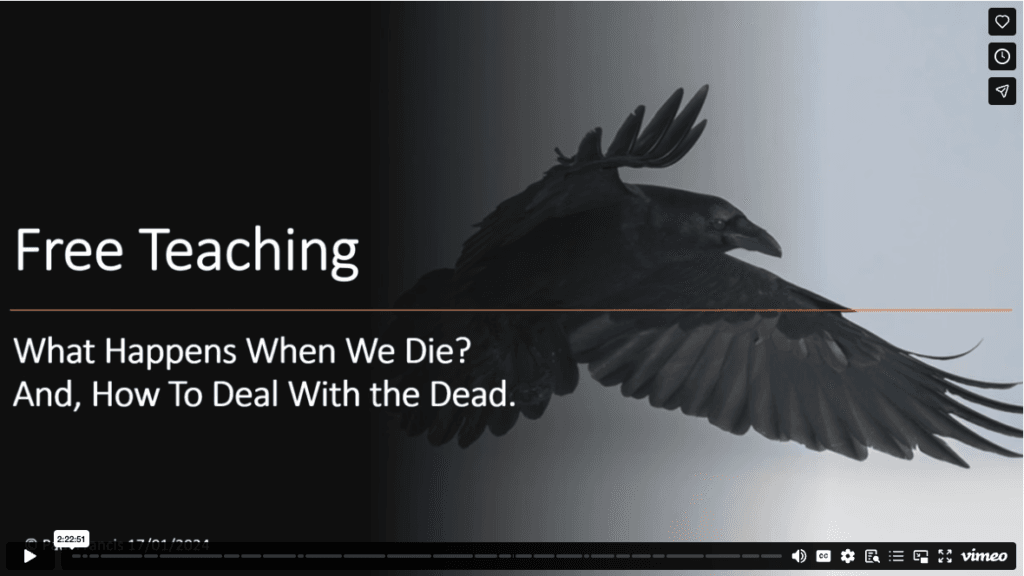
If you are already a Three Ravens student, there is a free teaching video that takes you into the heart of this material — what actually happens when we die, the parts of self, the Land of the Dead, and the unquiet dead. The course covers all of this in far greater depth and takes you into direct practice — it is where the map becomes experience.
practical DETAILS
The course consists of:
• 6 pre-recorded theory modules. Each module contains a video presentation of between 1 and 3 hours in length, with accompanying learning resources. They will be released at weekly intervals.
• As usual, a Signal group, where students can ask questions, discuss topics, share experiences and additional resources, and get support, encouragement, and a sense of community.
• Bonus recordings if and when needed.
In addition, there is the option of adding:
• 6 live shamanic journeying sessions. On each of the 6 dates above, there will also be a Live Shamanic Journeying session. These are optional, so you can buy the course without these (for £150), or add all 6 live sessions for just £15 more (a saving of 50% on the usual Live Sessions price). Whilst the Live Sessions are optional, people who attend them usually find them of great benefit. The Live Sessions start at 2pm UK time and are two hours long. Click here for more details of our Live Shamanic Journeying sessions.
FREQUENTLY ASKED QUESTIONS
Who is this course for?
It may be for you if:
- You feel called to a deeper, more honest relationship with death
- You are navigating grief, a significant ending, or a major life transition
- You work shamanically and want more clarity around the dead and the unquiet dead
- You are curious about how a clear relationship with death can change how you live
- You feel drawn toward eldership – simplification, perspective, what actually matters
- You want to do the work, not just read about it
It may not be for you if you are looking for reassurance, certainty, or a comfortable answer about what happens after we die. This course does not offer those things. What it offers is something more useful.
I'm a bit nervous about this topic. Is that okay?
Yes, completely. I’d be more surprised if you weren’t.
We live in a culture that has spent an enormous amount of energy teaching us not to look at death directly. Of course some part of you is nervous. That is not a problem. It is the ego doing exactly what it is designed to do.
What I can tell you is that the fear is almost always worse beforehand than it is in the actual work. You go only as far as you feel ready to go, and you have indefinite access to the course – so you can work at your own pace.
The question the course asks is not whether to feel afraid. It is: which part of you does the fear belong to? That turns out to be some of the most useful work on the whole course.
Do I need a background in shamanism to do this course?
Yes – and there are no exceptions to this. To join this course, you need to have completed our First-Steps course and at least one Next-Steps or Further-Steps course. The course builds directly on those foundations and assumes you already have that grounding and skills.
If you have not yet done First-Steps, that is the place to begin. There are also two Next-Steps courses running before July: Exploring the Lower-World and The Animal, Plant and Stone People.
Will I be pushed to work with the dead?
No. This course covers far more than psychopomp work — the parts of self, endings, grief, soul cultivation, and what death teaches us about how to live. If you prefer to stay away from working with the dead entirely, that is completely fine. Nobody is pushed into territory that doesn’t feel right.
Live Sessions
Alongside the six weekly modules, there is the option of joining six Live Shamanic Journeying sessions – one on each of the module release dates, starting at 2pm UK time and running for two hours.
These sessions are optional. You can buy the course without them. But people who attend consistently almost always find them of significant benefit – for the sense of community, for being able to ask questions, and for the quality of journeying that tends to happen in a group.
You can add all six live sessions for just £15 extra when you book. That is a 50% saving on the usual live session price.
Payment in instalments
We use PayPal, which offers a Pay Later option at checkout – spreading the cost across three monthly interest-free payments of £50 each. If you don’t see this option at checkout (it isn’t available in all countries), contact us and we’ll set up monthly invoices manually.
WHAT OUR STUDENTS SAY?
ANSWERS TO YOUR QUESTIONS
JOIN US!
To attend the ‘Living and Dying’ course, you need to have completed our First-Steps course, and at least one other, Next-Steps or Further-Steps, course with us (please note, there really are no exceptions to this). There are 2 Next-Steps courses you can take first:
Exploring the Lower-World
The Animal, Plant, Standing (Tree) and Stone People
This course is not running at the moment and is closed to new bookings. It is unlikely to be repeated until 2030 at the earliest.
Payment by instalments. We are committed to keeping our courses as affordable as we can, and this course is way cheaper than almost any comparable one. However, please remember that (depending on what country you are from) PayPal offers the option of spreading the payment over 3 monthly instalments. There is no fee at all for this, nor any interest incurred.
This course is not running at the moment and is closed to new bookings.