Hello!
There’s a question that comes up on almost every course I run. Sometimes it surfaces in the first session. Sometimes it’s in the message someone sends when they sign up. Sometimes it waits until the third or fourth week and then lands in the middle of something else entirely. But it’s always there.
What happens when we die?
And underneath that, quieter and more urgent: what does that mean for how I’m living now?
The How to Live and How to Die course exists because that question deserves a proper answer. Not a reassuring one. Not a spiritual bypass. A real one – grounded in the oldest human wisdom we have, and one that goes somewhere most teachings on this topic don’t: into practice. Into what actually changes when you stop keeping death at arm’s length and start letting it teach you.
If you’re curious about the course but not sure whether it’s right for you, the answers below should help.
To jump right to a specific question, click below:
TECHNICAL DETAILS:
COURSE CONTENT:
3 reasons not to miss this course
1. This course changes how you see your life
In over twenty years of teaching, the most consistent thing I hear from people who have done this work is not that they feel less afraid of death. It’s that they feel more present. Clearer about what matters. Less caught up in what doesn’t.
Shamanic traditions sometimes describe keeping death just behind the left shoulder – not as a morbid fixation, but as a quiet, steady awareness that all of this is finite. That awareness, when it’s grounded rather than anxious, has a clarifying effect that almost nothing else matches. It cuts through noise. It makes pretence harder. It keeps pointing you back toward what has real weight.
This course is not about becoming comfortable with death. It is about letting death show you how to live. Fully here, in this body, in this life — knowing who you actually are beneath the ego’s story, and giving that, genuinely, to the people around you and to the world. That is what a sane relationship with death makes possible.
2. Most modern spiritual teaching on death actively gets in the way
Reincarnation. Eternal life. Ascension. The idea that the self continues, in some form, indefinitely. These are reassuring ideas — and from an animist perspective, they are also relatively recent ones, emerging after the Fall, with the ego explosion and the rise of hierarchical religion. They are not part of original animist wisdom.
More than that: they are actively unhelpful. When death is something you can transcend — when the self simply moves on, continues, ascends to something higher — you no longer have to take this life seriously as the one you have. And that costs you something. It costs you the very thing death most wants to give you: the clarity that comes from knowing this is finite, this matters, and the way you spend your awareness now is what shapes everything.
There is also a subtler cost. The idea that death transforms you — that even if you’ve spent your life caught in fear, resentment, and ego, death will somehow resolve all of that — is one of the more persistent illusions of fallen culture. It doesn’t. Module 6 addresses this directly. The unquiet dead are not wise, peaceful beings. They are people. Some are kind, some are not. Death does not change that. How you die will largely be who you were when you were alive.
The animist answer to death is not transcendence. It is full embodiment. Knowing who you are. Giving that. Being of real service with the time you have.
3. Endings need to be endings – and most of us were never taught how
Things need to be allowed to end. Not just physical death. Relationships. Identities. Phases of life. Roles we’ve outgrown. Ways of being that have run their course.
When endings aren’t allowed to complete, the energy that should be released stays held. What looks like moving forward is often just carrying unfinished business into the next chapter. And then the next. The new beginning never quite feels fresh, because something old is still in the room.
This is one of the most practical things a proper relationship with death teaches – long before we die. How to let things end cleanly. How to grieve what needs to be grieved, at the pace it needs to be grieved, rather than rushing past it. How to allow winter to be winter — because without that, what grows in spring isn’t actually new. It’s just the old thing rearranged.
Who is this course for?
It may be for you if:
- You feel called to a deeper, more honest relationship with death
- You are navigating grief, a significant ending, or a life transition
- You work shamanically and want more clarity around death and dying and the unquiet dead
- You are curious about how death perspective can clarify and deepen the way you live
- You feel drawn toward eldership – simplification, perspective, what actually matters
- You want to do the work, not just read about it
It may not be for you if you are looking for reassurance, certainty, or comfortable answers.
Live Sessions
The live sessions will run alongside the How to live & How to Die course but will be open to anyone doing any course. So, if you’ve taken a First-Steps course with us and want to attend the live sessions, you’re absolutely welcome. These live sessions aren’t teaching sessions. They allow time for questions and answers regarding how to do shamanic journeys. They are shamanic journeying group sessions, although you don’t have to attend them.
The feedback we get is overwhelmingly positive – people who do attend find them incredibly useful, helping with motivation, learning from others’ journeys, and clarifying things. So, if you can attend, please do consider it.
You can sign up for the How to Live and How to Die without the live sessions for a slightly lower fee, or you can add them in as well.
Read more about live sessions here.
Miss the deadline, miss the course!
I have been getting a stream of emails from people saying they want to do the How to Live adn How To Die course, but who don’t want to sign up for it now. The expectation seems to be that we will still let them sign up for it at some point, even when the booking window has closed, so I want to clarify our position on this and explain the reasoning behind it.
This is not an open-ended registration course!
Some of the confusion may have come about because we have begun to offer some courses with open-ended registration (the new self-directed courses). To be clear, these are only some of the Next-Steps courses. The reason we have set these up is so that students who finish a First-Steps, and who are keen to keep exploring, have something to go straight onto.
Our other courses still have limited booking windows, though. The reason for this is that, without a booking deadline, if people think they can book a course whenever they want, what happens is that the number of bookings plummets. The reality is that, without deadlines to encourage people to book, the college would go out of business pretty quickly.
So, if you are interested in the The How to Live and How to Die course, you need to book before the deadline closes in July. Otherwise, you will be waiting a long time before the course is open to bookings again (as the course will go back to the bottom of the pile again regarding which courses we offer, and it will likely be several years before we can repeat it).
Remember, you can pay for the course in 3 monthly instalments (if you aren’t offered this by PayPal when you book, contact me, and I can set this up for you manually). Plus, even if you don’t feel ready to do the course at the moment, if you book on it, you have access to it indefinitely, so you can always do it in your own time and at your own pace.
Ongoing access and free course repeats
Ongoing access to the course
When you sign up for the courses, you have access to the recordings and the other teacher materials for life – life, of course, meaning for the life of the college. So as long as there’s a college running, and as long as the internet exists, you’ll have access to the recordings. So you can take as long as you want to work your way through a course, and you can come back to it and revise any bits of it as often as you want. It’s sort of like buying a book – once you bought the materials, you know, they’re yours and for as long as you want.
Do I need to have completed a Next-Steps course before signing up for the How to Live and How to Die Course?
You don’t! The How to Live and How to Die Course is a Further-Steps course. However, if you are at least enrolled on a Next-Steps course — you don’t need to have completed it — you can sign up for the How to Live and How to Die Course as well. Remember, once the current booking window closes for the How to Live and How to Die Course, the course is unlikely to run again until 2030 at the earliest, so please do seize this opportunity to book on it now, even if you haven’t completed a Next-Steps course yet!
Payment in three instalments
In terms of payment, we utilise PayPal, and you may be aware that PayPal offers a “Pay Later” option. When you book for the course, you will likely see a PayPal “Pay Later” option, allowing you to spread the payments in three interest-free instalments of £67 each. However, occasionally you may not see this button, as the option is not available in all countries worldwide, and for reasons that appear somewhat arbitrary, PayPal may not offer it to certain individuals. If you wish to pay in instalments but cannot find the “Pay Later” button, please contact me, and I will arrange to send you three monthly invoices instead, enabling you to pay in instalments that way.
THE CURRICULUM
(MIGHT BE SUBJECT TO CHANGE)
THE CURRICULUM
(MIGHT BE SUBJECT TO CHANGE)
What Happens When We Die?
The first question the course asks is also the most basic one: what actually happens? Not as philosophy, not as belief, but as something you can investigate directly through practice. We start here because everything else follows from it.
- We look at why our culture fears death so badly, and what that fear costs us.
- We look at the three conventional Western answers — heaven, reincarnation, the materialist ending — and at how the animist understanding differs from all three.
- And we introduce the map that underlies the whole course: the five parts of the self — Spirit, Soul, Body, ego, and the Aware Self — and where each goes at death. This is not a single self going somewhere. It is an inner tribe separating, each part returning to where it belongs.
- Choosing how to live — a reflection practice. If you knew how you wanted to die, and were honest about how you are living now, what would need to change?
- Words Before All Else — a gratitude practice spoken aloud before the day begins.
- Burial Journey — a Lower-World burial journey. You go to the axis mundi with your power animal, are taken to a place of burial, and allow yourself to die back into the earth. A death practice in the oldest sense: rehearsing the surrender that will one day be asked of you.
Psychopomping and the Unquiet Dead
Hunter-gatherer cultures put extraordinary energy — sometimes astonishing amounts of it — into making sure the dead moved on. They understood something we have largely forgotten: that the dead who linger are not at peace, and their presence is not good for the living.
What you will learn
- What psychopomping is, and why every animist tradition treats it as essential work. The universal understanding that the dead must move on — and the historical shift that broke that understanding in the West.
- The unquiet dead: what they are, why there are so many, and how their presence is felt. What happens when the dead do not move on.
- The difference between shamanism and mediumship.
- The Land of the Dead and what it is. The ancient instruction to head for the light — and what gets in the way.
- Possession and depossession: the full range, how to recognise it, and the basic process for working with it.
- Why you need a dedicated psychopomp guide, separate from your other allies.
- The medicine wheel revisited — why endings matter at every scale, and what happens to a person or a culture that cannot complete them.
- Meeting your psychopomp guide — a journey to find the guide whose specific work is with death. This is not a general-purpose ally. It is the guide you will work with when you encounter the dead, and the guide that will be there at your own death.
- Optional: a journey to meet Death as energy — for those who feel drawn to go further in this module.
The Grief Work
Most of us carry more grief than we know. Some of it is personal. Some of it is older — inherited, collective, ecological — and it has nowhere to go because the culture around us has no real container for it.
What you will learn
- Why grief matters for how we die, and why the ego resists it so effectively.
- The four strategies the ego uses to avoid grief: bypass, bargain, avoid, and drama — and how to recognise each.
- The three conditions grief needs in order to move: witness, time, and permission.
- The five gates of grief — the losses we carry that go beyond the personal — and why each gate, properly entered, opens something rather than closing it. Collective grief, ecological grief, and why we are living in a time of enormous unprocessed loss.
- Depression through a shamanic lens: not instead of appropriate medical care, but held alongside it. The difference between unfelt grief, unfelt anger, soul loss, and power loss — and how to begin to tell them apart.
- Recapitulation — dying to the past. The shamanic practice of going back through your life to retrieve what was left, release what was taken, and complete what was never finished.
- Shamanic life audit — a structured review of your life’s significant endings. Where have you completed the cycle? Where are you still in unfinished business?
- Disentanglements — working with the energetic cords that keep you bound to people, places, or events from which you have not yet freed yourself. Can be used with the living and the dead.
- The grief sit — a practice of sitting with grief without trying to resolve it. Giving it witness, time, and permission.
- Recapitulation practice. Going back to a specific time and beginning the work of completion.
Boundaried (Shitzoid) Type

- From conception to 6 months.
- Body type: small or tall, thin, angular, and disjointed.
- Key issue is not feeling safe to be here; not feeling welcomed, so never properly arrive on the earth. Feels they don’t belong. Unwanted. Chameleons (nothing feels real, so everything is an act/mask). Feels ‘weird’ and things feel ‘weird’. Difficulty with grounding and making contact.
- Examples: David Bowie, Lee Evans, Luna Lovegood, Vincent Van Gough.
Oral (Oral) Type

- 6 months to 2 years.
- Body type: thin, collapsed chest, s-shaped, child-like eyes.
- Key issue is feeling underfed, unsupported, and starved of love and nurture. Vulnerable. Longing, neediness, dependency. Nothing ever is enough.
- Examples: Kate Moss – waif-like models with cigarettes and big eyes.
Compensated Oral Type

- Has the same issues as Oral, but has responded by denying their neediness.
- Body type is wiry and athletic.
- Examples: marathon or fell runners and other lone endurance sports-types – proving to themselves that they can survive on their own.
Controlling (Psychopathic) Type

- 2 years to 4 years.
- Body type: either suave and charming or powerful and dominating.
- Key issue is it is not safe to be vulnerable; it is essential to be in control and to be top dog.
Dominating through charm, persuasion, manipulation and/or bullying. Charismatic. Confident. Narcissistic. Leaders. - Examples: Tony Blair, Peter Mandelson, Bill Clinton, John Prescott, Mussolini – most politicians!
Holding (Masochistic) Type

- 2 years to 4 years.
- Body type: overweight, burdened, rounded shoulders; can look a bit ‘put-on’.
- Key issue is it is not safe to be assertive. Must behave oneself and do as one is told. Good boy/girl. Duty and responsibility. Enduring. Long-suffering. Low self-esteem and confidence. Must not assert oneself or be fiery. Beast of burden. Self-sabotage. May hide behind being ‘jolly’.
- Examples: Dawn French, Timothy Spall, Nick Frost.
Thrusting (Phallic) Type

- 4 years to 7 years.
- Body type: rigid, athletic, upright; because of cultural gender norms, tend to be male.
- Key issue is they feel they are only worth what they achieve. Love is given to them for success and being good at things. It is not safe to collapse and underachieve. Stiff upper lip. Captain of cricket and then of industry. Officers. Pushers and perfectionists.
- Examples: Richard Branson, David Beckham, public schoolboys, armed forces officers – the people who ‘built’ the British empire.
Crisis (Hysteric) Type

- 4 years to 7 years.
- Body type: overtly sexual, exaggerates sexual characteristics; because of cultural gender norms, tend to be female.
- Key issue is they get attention and self-esteem from being sexual and attention-seeking, but feel conflicted about this. Sexualises most interactions. Needs to be the centre of attention. Drama queen. Goes from crisis to crisis. Dramatic. Exciting. Melodramatic.
- Examples: most hyper-sexualised female pop-stars, ‘babe’ culture.
Denying Crisis Type

- Same issues as crisis type but more conflicted about the attention, so is cooler and unobtainable. Aloof. ‘You can look but you cannot touch’. The Ice Queen.
- Examples: Meryl Streep, Sharon Stone, Isabella Rossellini, Ingrid Bergman.
Ancestral Grief
We carry more than our own history. The grief of those who came before us moves through us in ways that science is only beginning to map, and that shamanism has always known. What we do not grieve, we pass on. What we do not heal, our children inherit.
What you will learn
- The Aware Self in more depth: what it is, what it is not, and how to cultivate it as a lifetime’s practice.
- Why hollowing out — learning to hold experience without blending with it — is central to all shamanic work, and especially to working with death.
- Ancestral grief: what we carry forward from those who came before us, and what science is beginning to confirm about how that transmission works.
- Why healing the ancestral line is not simply personal work — it is work that moves in both directions.
- What a proper ritual container requires, and why specific elements — including salt — are used. How to prepare to work with what has been inherited.
- The Salt Bowl Ceremony — a ritual for working with ancestral grief. Salt is drawn from your body as tears. What you pour into the bowl is what has been carried — personal, familial, collective. The ceremony is a way of acknowledging what has been inherited, beginning the work of not passing it forward.
- The salt bowl journey — the shamanic journey that accompanies and deepens the ceremony.
Soul
There is a part of you that knows what you came here to do. Not your goals, not your ambitions, not what you think you should want. Something older than all of that. In animism this is the Soul — the Lower-World self, the part of you most deeply rooted in what you actually are.
What you will learn
- What Soul is — and what it is not. The difference between Spirit and Soul in animism, and why confusing them is a significant error. Soul as the Lower-World self, the part of you that knows what you were most deeply meant to be and do in this life.
- The relationship between Soul and the body. How Soul speaks — through longing, through the things that have always called to you, through what you have been avoiding.
- Why depression is often, at least in part, unexpressed grief and soul loss — and what it looks like when someone has lived too long at a distance from their own Soul.
- Why the work of finding and living from Soul is not optional: it is the central question of a human life, and the most important preparation for death.
- How to map the territory of your Soul. Looking back at when your Soul was calling most clearly. Your core values, abilities, and knowledge — not as a CV exercise, but as a way of hearing what is most true.
Journey to the place of your Soul — going to the territory of the Lower World where your Soul lives, and beginning to learn its landscape.
Journey to meet your Soul — a direct encounter. What does it look like? What has it been trying to tell you?
Journey back to yourself — returning to a specific time when your Soul was calling clearly, before you stopped listening. What was it saying? What did you do instead?
The Final Synthesis
The course ends where it began: with the question of how to die well. But by now the answer looks different. It is not about preparation at the end. It is about how you are living now.
What you will learn
- How you die will largely be determined by how you have been living. Not as judgment, but as orientation. The greatest preparation for death is not something you do at the end — it is what you practice now.
- The course ends with seven principles for living and dying well. Each one is a direction of travel, not a destination. They draw on everything the course has covered — and together they form a practice you can carry for the rest of your life.
- What the West has independently confirmed about all of this — and why the convergence matters.
- Long-term practices for carrying this work forward after the course ends.
- The concept of refugia: places of sanctuary and continuity from which life regenerates after loss.
- The closing reflections for the whole course.
- Words Before All Else — deepened now as a long-term daily practice
- Gratitude to the more-than-human world — daily orientation toward what sustains us.
- Annual mortality review — a yearly practice of sitting with the fact of your death, reviewing the past year, and asking what the coming year is for.
- Soul retrieval — a journey focused on the times in your life when your Soul was calling most clearly. Retrieving what was left there. Bringing it home.
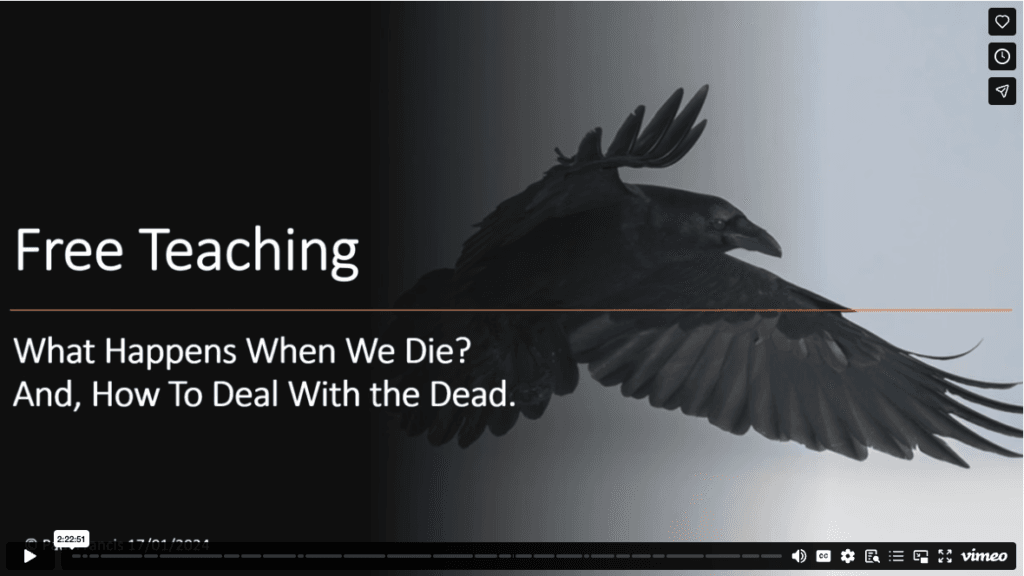
If you are already a Three Ravens student, there is a free teaching video that takes you into the heart of this material — what actually happens when we die, the parts of self, the Land of the Dead, and the unquiet dead. The course covers all of this in far greater depth and takes you into direct practice — it is where the map becomes experience.
What happens when we die?
The first thing I always say about death is this: nobody actually knows what happens.
Some people have very strong opinions about it. Different cultures and religions often have quite different ideas. Near-death experiences are frequently offered as evidence, but when you look at cross-cultural studies, people from different cultures tend to report different things – which strongly suggests that what they are experiencing is shaped by their own beliefs and middle-world self, rather than some objective picture of what lies beyond.
So we are in the realm of speculation. And that is actually the most honest and useful place to start.
From an animist perspective, we are not a single self that either continues or disappears at death. We are a temporary coming-together of different parts – an inner tribe – and at death, those parts go their separate ways. Death is not continuation. It is separation. And that distinction matters enormously for everything that follows.
There are five parts:
Spirit
Spirit is our upper-world aspect. Like a drop of water in an ocean, at death spirit returns to that ocean. No individual continuity. It becomes part of something much larger.
Soul
Soul is our lower-world aspect, part of the human over-soul. This is the part most distinctly our own – not in the ego sense, but in the deeper sense of what makes us who we are beneath the accumulated stories. Crucially, Soul is the part that can be cultivated during life. A soul that has been found and tended becomes something that can be followed at death. A soul that was never attended to cannot be followed, because it was never fully there. This is why Module 5 sits at the heart of the whole course.
The Body
The body is made of the stone people, temporarily dancing as flesh and bone. At death it returns to the earth and becomes part of other things.
The Ego
The ego, or middle-world self is the story of who we are: our identity, history, accumulated sense of self. It is also the part most afraid of death, for obvious reasons. Like a leaf on a tree – while alive, its job is to serve the tree. When the time comes, it falls. A healthy leaf composts and feeds the next growth. A diseased leaf – one that spent its time claiming independence from the tree – contributes nothing in return.
The Witness
The aware self, or the Witness, is a part of us that has no personality, no emotions, no history of its own. It is simply awareness – an inner torch that can be directed toward any of the other parts. Where it goes at death depends almost entirely on where you have practised directing it during your life.
How you die will largely be determined by how you have lived, what you have practised, and where you have habitually placed your awareness. Understanding that – really sitting with it – is what Module 1 is for.
Is reincarnation part of shamanism?
Of the hundreds of hunter-gatherer cultures that have been studied, I could only find two that showed any belief in it at all – and even then, only occasionally, and in forms quite different from how the idea is usually understood. One hoped to come back as a tree. That is not really what most people have in mind.
Reincarnation as a widespread belief only appears after the Fall – the shift roughly 4,000 years ago away from hunter-gatherer animism and toward agriculture, hierarchy, and what some researchers call the ego explosion. It emerges with the same religions and civilisations that brought gods that judge, eternal reward and punishment, and the idea of a persistent individual self.
The question I always find worth sitting with: for around 195,000 years, extraordinarily wise shamans were working in the shamanic realms. How come none of them discovered reincarnation? (Free video: 16:54)
The usual answer is that we are now more spiritually evolved. I don’t see evidence for that. By almost any sane measure – mental health, ecological relationship, community cohesion – animist cultures were far healthier than we are.
More than that: the idea is actively unhelpful. When death is something you can transcend – when the self simply moves on, continues, ascends – you no longer have to take this life seriously as the one you have. And that costs you the very thing death most wants to give you: the clarity that comes from knowing this is finite, this matters, and the way you spend your awareness now is what shapes everything.
As for past-life memories – because we are all part of the human over-soul, we can access experiences and lives that others have lived. That is not reincarnation. It is something more interesting – and more consistent with what animism actually teaches about the nature of soul. That distinction, and what it means in practice, is something we go into properly on the course.
What are the unquiet dead - and do I need to work with them?
The unquiet dead are people who have died but not moved on – still occupying the middle world rather than moving toward the Land of the Dead.
The reasons are usually quite human. Unfinished business. Being held back by a grieving person who won’t let go. Fear of what comes next. Confusion – sometimes not knowing they are dead. These are understandable reasons. But death energy is not life-friendly. Prolonged proximity to it costs the living something – in ways that show up as heaviness, flatness, a sense of something not quite right. Hunter-gatherer cultures understood this clearly and built their practices around it. I visited an exhibition at the Tropenmuseum in Amsterdam some years ago, organised chronologically to show how different cultures dealt with death. The pattern was unmistakeable. The most ancient, genuinely hunter-gatherer cultures were unambiguous: the dead must leave, and leave cleanly. Giant carved doors in yurts used only to carry the dead out, then barred against return. Tall carved poles with inscriptions commanding the dead to go. As cultures became more settled, they began keeping the dead close. Skulls on mantlepieces. Annual exhumations. The shift was stark – and something essential was lost with it.You do not have to work with the unquiet dead on this course. If you prefer to stay away from middle-world and psychopomp work entirely, that is completely fine. Nobody is pushed into territory that doesn’t feel right.
If you do want to do that work, though, Module 2 covers it properly – including why you need a separate psychopomp guide, what protection looks like in practice, when to step back and let your guides do it rather than going in yourself, and why the distinction between shamanism and mediumship matters here.Is this course about grief?
Grief belongs here because it is the natural companion of every real ending. Our culture has profoundly misunderstood what grief is. We treat it as a problem – something to be processed, moved through, eventually resolved. From an animist perspective, grief is not an obstacle. It is a process – the natural movement of loss through a person. Like all natural processes, it has its own pace, its own intelligence, its own season. The only way it goes wrong is when we interfere: rush it, suppress it, decide we should be over it by now.
When grief is not allowed to move at its own pace, it doesn’t disappear. It goes sideways. It surfaces as numbness, flatness, a strangeness in experiences that should feel alive.Many of us are also carrying more grief than we know. Not just personal grief, but collective grief – for what has been lost in the shift away from a more sane and connected way of living. Ecological grief, for the living world we have watched diminish. And ancestral grief – unresolved loss passed down through generations, shaping us in ways we rarely notice until we look directly at it. In Module 5 there is a specific ceremony using a bowl of sea salt where you work with what your lineage is carrying – offering to take ancestral grief and release it. That is not a visualisation exercise. It is shamanic work that people find unexpectedly direct.But the course is not grief therapy. Grief is one thread. The full picture includes the parts of self, the Land of the Dead, soul cultivation, eldership, and what you want to do with the time you have.
What are the practices we will do on the course?
This is what separates this course from reading about these topics or thinking about them.
Practices include:
- The burial journey – one of the oldest transformation practices in shamanism. You journey to your own burial, observe it, and discover what remains when the middle-world self has been set aside. For most people, this is the most significant journey they have ever done.
- Dying, dissolving, burning and cocooning in journeys – meeting the life-death cycle directly
- Getting your psychopomp guide and learning to work safely with the unquiet dead
- Middle-world protection practices
- Meeting your older and future selves
- Ancestral unburdening journeys and the salt bowl ceremony
- Finding and strengthening your connection with Soul
- Soul retrieval from the Land of the Dead
- The year-to-live practice – one of the most clarifying exercises in this work
- Recapitulation – dying to the past; identifying what you are still carrying and beginning to put it down
- Long-term practices for the life after the course: daily acknowledgement, gratitude to the more-than-human, an annual mortality review
Some of these will be familiar from other courses. Some are specific to this one. All of them are done with full shamanic support – your guides, the structure of the course, and the community of students working alongside you.
I hope to see you on the course!
The course starts on Saturday 4th July 2026 and consists of:
• 6 pre-recorded theory modules. Each module contains a video presentation of between 1 and 3 hours in length, with accompanying learning resources. They will be released at weekly intervals. The dates are July 4th, 11th, 18th, 25th, August 1st, 8th.
• As usual, a Signal group, where students can ask questions, discuss topics, share experiences and additional resources, and get support, encouragement, and a sense of community.
• Bonus recordings if and when needed.
In addition, there is the option of adding:
• 6 live shamanic journeying sessions. On each of the 6 dates above, there will also be a Live Shamanic Journeying session. These are optional, so you can buy the course without these (for £150), or add all 6 live sessions for just £15 more (a saving of 50% on the usual Live Sessions price). Whilst the Live Sessions are optional, people who attend them usually find them of great benefit. The Live Sessions start at 2pm UK time and are two hours long. Click here for more details of our Live Shamanic Journeying sessions.
Blessings,
Paul Francis